Showing posts with label guest posts. Show all posts

Wednesday, 30 August 2017

Writing in the library

This is a guest post from Dave Beer, Reader in Sociology, reblogged from his own Medium page with permission. All the images are by Dave too.


I’m working on a book at the moment. It’s largely drafted and I’m trying to work it into shape. I always find it a bit of a slog when I’m having to read my own words back, again and again. I keep the writing and editing stages very seperate, which means that I’m often working with an extremely rough draft that need lots of work over several months. It’s a slow process. This is when I tend to turn to the library. When it comes to the trickier bits of writing and editing — whether it’s books, chapters or articles I’m working on — I’ve found that relocating to the library can help a little. The slog is the same, but being surrounded by books seems to give the work a little bit of an encouraging nudge.


The library is a bit of a bubble. I use it more in the gaps between terms. In the ebb and flow of the academic year — described beautifully in Les Back’s book Academic Diary: Or Why Higher Education Still Matters — the library space is most welcoming at the time when my own diary is at it’s thinnest. I’m in the library now, writing this short piece as a way of getting warmed up for a few hours of editing. The library space just seems to invite thinking and writing. Wifi connects me into the usual networks, but the space seems somehow to provide a refuge from the distractions and endless flows of information that call for our attention. It frowns on anything too fivilous; Twitter mentions and the like. The attention economy still calls to us through our devices, but somehow the quiet contemplation of the library space suggsts to us that we should be ignoring it and directing our attention elswhere.
In terms of our connectivity, the spaces of the library are no different to anywhere else. They just feel different. Part of the this is the kind of affective properties that are designed into the spaces — they are put together to make you feel a certain way. But the bigger presence is that of the books. Even if we are not taking them off the shelves, the books set the tone for the space. Their physical presence, looming down from the shelves, reminds you of the history of knowledge. This is partly liberating because, as when looking at pictures of outer space, I’m reminded of the meagreness of what I am contributing. The enormity of knowledge is there on display in the library. This frees me up becuase of the perspective it gives to the writing.

I think though the tone of the library is also a product of how evocative the books are. A little while ago I wrote a short piece about the properties of old books. That short piece used both Sherry Turkle’s notion of ‘evocative objects’ and Walte Benjamin’s account of the importance of the materiality of books to reflect on why working with old books is so interesting. Their yellowed pages suggest something of their past and istantly evoke a history of use — a material biography. When we sit amonst them rows of them we are placed within a mass of those historcial traces. The presence of shelves full of old books has a collective effect. The impact of evocative objects is multiplied when they are displayed in concert. The library space is where these evocative obejcts intersect and their dusty dogeared and sun-lightened spines tell stories of accumulating knowledge. The aura of these obejcts is powerful in itself — we need not always be working from these books to feel a sense of the weight of knowledge and the history of thinking that they evoke.

Writing spaces matter. The environment we write in inevitably shapes the work (as an example, I previously I wrote this short piece on the book I wrote whilst sitting in a fold up chair and leaning on a towel box). The liberating enormity and evocative presence of the library’s books make it a place to think and work that, I think, adds some energy and a bit of fizz to what I’m doing. It’s a space I tend to turn to when I need a bit of a push to keep writing or to keep editing. Sometimes I fetch those books come down from the shelves to inform what I’m doing, but often they sit there suggesting to me to think more, to be a bit freer and to get on with it.


Wednesday, 16 July 2014

A sprint or a marathon?

As they complete work on the new student accommodation interface, Laura Hallett and Kathryn Woodroof provide an insight into their project management style.

Replacing a key enterprise system in any organisation comes with a fair number of challenges. You're faced with a stakeholder group reaching almost 100 who each have their own individual view on life "in the new world", existing enterprise systems to integrate with in a sophisticated manner, and project staff who have their day jobs to manage alongside successful implementation. The project to replace our student accommodation system started in September 2013. It should go live to our returning students applying for accommodation on campus, in November.

There comes a point in any project when you have to knuckle down and get on with the work of developing the product. We talked and consulted, planned and then planned some more, and then KxStudent was installed. Right, time to start moulding it to our requirements. But what's the best way of developing one of the University's essential business systems? How and where do you keep track of all of the detail and the decisions? These were questions that we hoped to answer during the project.

The University moved to Google Apps for Education in 2011. It's fair to say that most people on this project are now Googlephiles. The project team is made up of busy people from five very busy departments. Calendars being what they are, it's not always easy to get everyone together. In order to make the most of our face-to-face time, we have to communicate efficiently in-between meetings. Google Apps has enabled us to do this. The project documentation is saved on our Google Drive. Google Docs can be edited simultaneously, with a full revision history, and you can make comments or chat to your colleagues whilst editing. You can make yourself available for quick questions on Google Hangouts if colleagues are doing a testing session and you can’t make it. Google Calendar gives you an at-a-glance overview of the team’s availability and allows you to schedule repeat meetings easily.

OK, not this sort of scrum.
Scrum by David - used under a Creative Commons license
When you do get together, it's important to be efficient - never more so than in our meetings about the interface between KxStudent and SITS. The interface development has been iterative - we're on our eighth version of the specification - it can be easy to lose focus and motivation. Many technical readers will be familiar with the Scrum framework, which is used for complex product development. Whilst we have not consciously adopted the Scrum methodology for this project we do find ourselves using some of the processes sub-consciously. Our interface meetings are a bit like a Daily Scrum. We review what has been accomplished since the last meeting, discuss any blockers and agree what will be done before the next meeting. The development work itself is done between meetings (using Google Apps, of course) in what might be called Sprints. Although sometimes they feel like marathons!

The interface will be completed and signed off soon. But whilst it's the end of this phase of the project, I'm sure it won't be the end of dynamic and collaborative working. We'll take our favoured approaches and the lessons that we have learnt and apply them to the next phase - web development.

Monday, 7 July 2014

The Neuton Project (no, that's not a typo)

A guest post from Hannah Jeans, an intern from the Institute for the Public Understanding of the Past who worked with us on the Neuton Project

This year marks the 600th anniversary of the re-founding of York’s Minster Library, when in 1414 the cathedral’s treasurer, John Neuton, bequeathed his book collection.


There had been a library connected to York Minster before: Alcuin is well-known for his part in building up the cathedral’s library in the eighth century. However, this library was destroyed when the Danes sacked the city in the late ninth century.

YM MS.XVI.P8 fo. 1r
A page from one of Neuton's manuscripts, still held in the Minster today.
Click to enlarge image.
Neuton was the son of a local merchant, and probably attended school in York before going on to study law at Cambridge - he may well have been taught at the Minster school. He was clearly an avid book collector: at the time of his death he had built up a collection of around 100 manuscripts. He left a large proportion of these to the Minster, but some also went to his old college, Peterhouse, in Cambridge. The books he left to the Minster show his wide range of intellectual interests, including theology, history and law. Over the centuries this collection was added to, but unfortunately few of the original manuscripts now survive.

Neuton's bequest stimulated the creation of a library building to hold the cathedral’s books. The original medieval library building, completed just a few years after Neuton's bequest, was attached to the south transept, above what is now the gift shop. The ground floor was used for the Minster school. In the nineteenth century the library was moved to the Old Palace, where it remains today and the space is now used for choir practice.

To mark this anniversary, an online resource is being created, covering Neuton’s life and his bequest, and the wider context of late medieval York and the Minster. There will be contributions from various academics; images of the few remaining manuscripts that belonged to Neuton; and the website will aim to put Neuton and his bequest in context of the longer-term history of the Minster Library. Some very interesting and cutting edge research has already come out of the project. In a great piece of detective work, Sarah Brown, head of the York Glaziers Trust, has identified where in the Minster she believes Neuton was buried.

The website will be an excellent opportunity to view images of medieval manuscripts, which are normally not that accessible for the wider public, and to learn more about the long and rich history of the Minster Library.

John Neuton and the re-foundation of the Minster Library featured in the Cathedral Libraries and Archives in the British Isles ‌Conference in July. For more information visit:

Thursday, 3 July 2014

How to cycle as fast as Bradley Wiggins...

A special Tour de France guest post by Dr Phil Lightfoot - Department of Physics

Unfortunately for my employers, the best ideas always seem to come to me en route to and from work, while cycling to the University on my mountain bike.


Temporarily disconnected from the web, my thoughts are forced inward and my imagination begins to wander. Despite the fact that the design has failed to significantly evolve in over 100 years, bicycles still represent the most convenient and efficient means of human powered transportation.


Photo: Bradley Wiggins, by Surrey County Council.
Reproduced under a Creative Commons licence.
But why has bicycle design appeared to stagnate while the technology associated with motorcycles has consistently developed? What is the limiting factor and what can be done to overcome it? The answer regrettably is hitting cyclists in the face daily.

The average speed of winners of the Tour de France in the last 10 years is 24.9 mph. My highest recorded average speed along 8 miles of quiet country roads between the Physics department and a very disgruntled hungry cat stands at 19.5 mph. At first glance it may therefore seem within the realms of possibility that I could dedicate every fibre to pushing the envelope and bridging this small speed differential.

Sadly physics has other ideas.

Setting aside the world of lycra for a moment, let us consider petrol-powered transport:
  • A Bugatti Veyron sports car uses 987 horsepower (hp) to propel it to an impressive top speed of 267 mph;
  • But a Ford Fiesta needs only 99 hp to reach roughly half that speed. 
  • Perhaps the best evidence of basic physics at work was the top speed of 172 mph set by a 78 hp Moto Guzzi motorcycle in 1957 (it was almost 20 years before that speed was reached again in racing). 
  • This feat was attributed not to the power of its engine but to the aerodynamics of its design. 

Isaac Newton is largely responsible for deciphering the associated physics. Basic Newtonian mechanics states that at top speed the net force propelling a vehicle forwards must equal the net force dragging it in the opposite direction. Therefore in order to increase top speed without any increase in supplied power, the forces of drag must be reduced.

So, to relate that back to bicycles: drag associated with cycling is made up of rolling resistance and aerodynamic drag. The force Frr due to rolling resistance is given by the relatively intimidating expression (below) in which Wf and Wr refer to the weight acting through the front and rear tyres and P is the pressure within them. The constants a, b and c depend on a number of factors such as the road surface, bearing friction, tyre construction, surface temperature and the ‘knobbliness’ of the tread pattern.


The only good news is that rolling resistance can be significantly reduced by decreasing the weight of the rider and bicycle, increasing the tyre pressures, and reducing the contact patch made between the tyres and the ground. Tour de France racing tyres for example are triple the pressure and a third the width of the tractor tyres fitted to my bicycle. The riders too are approximately half my weight.

Aerodynamic drag is a result of the viscosity of air, a boundary layer forming around the bicycle which affects pressure distribution and disrupts the smooth laminar flow. This disturbance creates an area of high pressure directly in front of the rider - reducing forward velocity.

Alexander Vinokourov.jpg - Wikimedia Commons.
Used under a Creative Commons licence.
Perhaps a little surprisingly however, the shape of the rear of the bicycle/rider combination has a greater effect on drag than the shape of the front because of the turbulence created as disturbed air falls into the partial vacuum created. As is equally true for aircraft wings, the optimum shape in order to reduce aerodynamic drag is widest at 20% of its length and then tapers by 10 degrees from there rearwards. This explains some of the weird and wonderful shapes of helmets and bikes you see in professional time trials (it doesn't explain the colours however).

    
The figures above demonstrate airflow around (a) the torso of an upright commuter, (b) an unprotected head, and (c) the aero-helmets commonly used by time trial racers. Any sharp variation in profile leads to the onset of turbulence, the air unable to follow the contours of the shape generating a partial vacuum which further upsets flow. 

The total aerodynamic drag force in newtons is given by the following expression for which v is the speed in m/s and A is the projected frontal area in m2. The drag coefficient Cd  depends on the shape and surface smoothness of the object and the nature of the medium through which it travels. Cd  is 2.0 for a flat plate perpendicular to the air, 1.0 for a smooth ball, 0.3 for a sports car, 0.7 for a mountain bike and anything down to 0.2 for a race bike and professional rider.


VeloX3.jpg - Wikimedia Commons. Used under a Creative Commons licence.
Incidentally, it is always the case that a compromise must be reached between the drag coefficient and the projected frontal area, a streamlined flow necessitating a more bulbous shape. For example the current unassisted land speed record for a bicycle of 83 mph was set in 2013 by VeloX3, a recumbent design encased in a large aerodynamic faring.

This information provides us with a key insight. First however we must revisit Newton who determined the relationship between power P in watts, speed v in m/s and propulsive force Fdrive in newtons given below.


The current motor-paced record, in which a cyclist rides directly behind a powered vehicle shielding the rider from the effects of drag, stands at 167 mph. This indicates the dominance of aerodynamic drag. If we neglect rolling resistance and equate the forces of aerodynamic drag and propulsion we arrive at the following expression. Remember that if the propulsive and drag forces balance, there is no net force and so v will represent top speed.


The specific values aren't as interesting as the relationship between power and top speed which suggests that in order to double top speed, a rider must supply eight times the power. I can cycle at 20 mph and Wiggins and the other professionals can easily cycle at 25 mph; however that 5 mph difference between commuter and pro-racer corresponds to almost double the power output. Not even a grumpy cat is able to provide sufficient encouragement for me to span that divide!

Not the author's cat. Picture courtesy of www.catshaming.co.uk.

Wednesday, 25 June 2014

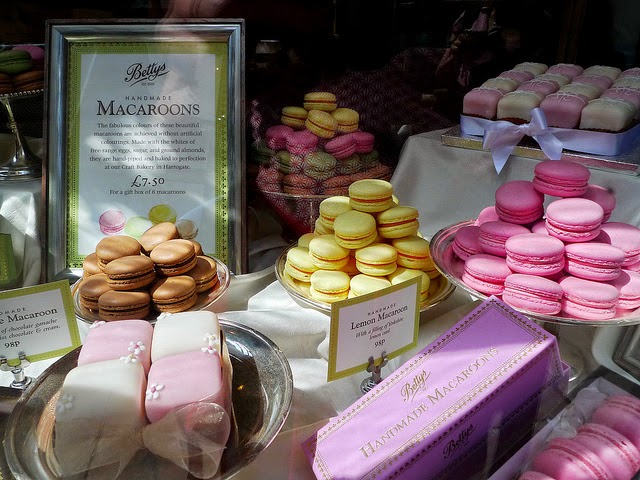
Bettys (no apostrophe, please) - the taste of Yorkshire

We're pleased to publish our second guest blog post from Alison Barrow, a former student of the University of York and now Director of Media Relations at Transworld Publishers.


A writer once gave me an exercise. "Close your eyes," she said. "If you concentrate really hard, the noises around you will sing out and you will pick up the most resonating sounds. Commit them to memory, and you will be able to transport yourself back anywhere, anytime."

The sounds emerging from Bettys wouldn't be the first to leap to mind when conjuring up the place. Smells, yes. Tastes, most certainly. But listen... close your eyes and you can hear it. The clink of silver on china, the swish of a crisp ironed pinny, the languorous pouring of tearoom blend, the scrape of butter on a Fat Rascal. And the sighs - the murmur of cafe chat and contented munching. The sipping of coffee. The "oh, go on then," reception of the cake trolley.

Little Bettys by Tania Ho
Used under a Creative Commons license.
Bettys was a rare treat in my student days. Somewhere to take a visiting relative (in the hope that they would cover the bill), a weekend indulgence with a friend - sharing a pot of tea for one and a fondant fancy. We would persuade ourselves we deserved it after a full week of lectures/exams/seminars/partying. Reassuringly comforting, Bettys on the corner of St Helens Square always had a queue. It was (and is) part of the ritual. Baby sister Little Bettys on Stonegate offered the shelter of a spiraling waiting line up the stairs - under cover from the rain. Sloping floors and well-trodden carpets emanated a sense of history. We would sit there for hours - or until the gentle hovering of a waitress would hurry us along.

I first went to Bettys as a young child in Harrogate, where I was born. The cafe then was on Cambridge Crescent, not the current domineering location on Montpelier Square, and my grandmother would slavishly order the same each visit. A pot of tearoom blend and a vanilla slice (for her) and a glass of chilled milk (full fat - for me). I have never understood the appeal of the vanilla slice, nor the curious method of tackling the mountain of it with a tiny dessert fork. When she had nearly finished - and this happened every time - she would offer a forkful over the table to me. It would have been rude to refuse.

When my family moved south, my parents would drive back to Harrogate, stopping in to see the relatives and dropping in to Bettys for curd tart (for my mother), Fat Rascals (for my father and brother) and pineapple fondant tarts - which made a fleeting appearance on the menu in the later years of the 20th century, but sadly are but a sticky memory - (for me). Does everyone have a favourite? A beloved colleague of mine introduced me to cinnamon toast many years ago. I associate it with him every time, that subtle blend of spice, buttery liquid and sugar, delicious. Thank you, Martin.

Bettys Tea Rooms by Steve Harris
Used under a Creative Commons license
From those sugar-encrusted memories to the present day - now we order Bettys tea, coffee and bakery online. I have a running account and have mailed many goods across the world, sharing a taste of Yorkshire. Now there is a coffee shop on many corners in York, in Harrogate, across the whole of Yorkshire, the country. Now there are a myriad of choices, of blends, of options. And yet. One constant remains. Thank you, Bettys, for standing firm and proud within the confines of Yorkshire, thank you for warming us with your enriching food and drink, polite service and company and for changing so very little over the years.

This week I will return to Bettys York once more. Along with a group of university friends from the 1980s, a day trip for a momentous birthday. Bettys for tea. What shall I have? I'm not really that sure yet (definitely not a vanilla slice). But one thing I know. For a moment, a fleeting moment so short nobody will ever notice it, I will close my eyes and hear the sound of Bettys. And once again, I'll be home.

Thursday, 5 June 2014

Guest post: Review of the Sage Research Methods online collection

As a second year PhD researcher at the York Management School, I have found the Sage Research Methods online collection a useful tool for my research. The collection covers everything from explaining to a new researcher how to write about a piece of research, to various methodologies in social science research for intermediate and advanced researchers. In terms of research preparation, it’s a great place to start and a highly-recommended reference point for students. If you need help using it, you can just click on the Video button to see step-by-step instructions.


The collection contains encyclopaedias, handbooks and other important resources in research methodology that include qualitative and quantitative methods. It also has content from hundreds of dictionaries, and guides on particular subjects along with Sage Journals content and videos. This is broad and varied access to quality resources for social science researchers. 

Searching is easy and the interface is user-friendly: options include browsing and searching related topics and methodologies. You can move straight from the results list to contents and methods, and explore the relationship between the two. Advanced search features allow you to search the full text, method, title, author, journals, and more. The only drawback I experienced when using the search box was not being able to find a journal that contained more than one keyword. For instance, I tried to search for a journal which contains the words 'Immigrant Entrepreneurs' and the results contained either 'Immigrant' or 'Entrepreneurs'. However, it is still a very useful tool to learn about writing research - especially for a beginner. 

Methodology is crucial to a piece of research and Sage Research Methods online collection makes things easier. Methodologies available in the database include basic statistics, advanced statistics, quantitative methods, and qualitative methods making this tool suitable for all levels of researcher – from beginner to expert. 

Method maps and method browsers allow the user to view all the possible and relevant methodologies available. This is very exciting and easy to use because users can just click on the bullet points in the page to can see lists of concepts and philosophies, literature reviews, mixed methods, qualitative research, quantitative research and research design. Selecting a topic directs the users to explore more, suggesting relevant books and journals for their research. Unfortunately, there is no back or next button on this page - the user has to click on the back button in the browser instead. However, it is still helpful that a good reference is provided for the research method. 

Selecting the Show Content box shows two book series included in the collection - Little Green Books and Little Blue Books. The Little Green Books discuss the most topical questions about quantitative research within the social sciences while the Little Blue Books focus on qualitative research is well suited to nascent research, and to those who wish to widen their methodology list.


Nur Suhaili Ramli,
Doctoral researcher
The York Management School


Wednesday, 7 May 2014

Telling Tales

Photo: Stonegate Night bw by Ravensthorpe.
Reproduced under a Creative Commons licence.

Back in the 1980s student life at the University of York was uninterrupted by social media. The internet was in its infancy and computer science students booked their hour-long sessions in the computer block just down from the Library (where we searched for books on microfiche). For entertainment, there were TV sets in the common rooms. We hunkered down in front of The Young Ones and had all-night horror movie sessions, mesmerised by the special effects in American Werewolf in London. The JB Morrell was closed on Sundays. Some of us (whisper it) read books for fun. We read alone. We didn't talk about it. There were no book clubs, nor did we spend much time recommending to our friends. It wouldn't occur to us to do so.

Tales of the City was just six years old when first I discovered a copy in Godfreys bookshop in Stonegate. A story of a naive young assistant moving from sleepy Cleveland to wide awake, loud and colourful San Francisco was the peak of exotic adventure to a student from North Yorkshire. The girl on the (cord) phone on the cover looked so glamorous. Standing at the back of the shop I read 25 pages (to 'Edgar blows up') and that was it. Hooked. 60p a paperback. In the days when we extracted five pound notes from the cash points in Heslington to last a whole weekend, this purchase was a little luxury.

I loved Mary Ann Singleton. She was embarking on a whole new life adventure. (In later episodes, when Maupin turned his sharp pen to harden her character, I am momentarily saddened, but for now she was the girl I wanted to be.) After the weekend, I headed back into town, back to Godfreys to discover there were sequels - More Tales of the City, Further Tales of the City and one, deliciously entitled Babycakes. I read and reread, tracing every nuance, every development, laughing and weeping, but all alone. It never crossed my mind to share my love of these books. We just didn't, then.

Glide forward seven years and there I am, standing at the airport arrivals hall, holding my copy of Maybe the Moon. Feeling a little nervous, a little excited.

Alison Claire Barrow was twenty-one years old when quietly she discovered Armistead Maupin for the first time. Seven years later she is meeting him at Heathrow to accompany him on his UK book tour. Twenty nine years later (pinch me, where did that time go?) she is his long-term UK publicist and proudly out there and loud about it in this, her first ever blog, in the media, in events - and relentlessly on social media. How lucky am I? And still, in my head, sometimes I'm the girl back in Derwent College, flat out on the thin mattress of my bed on the second floor of A block, lit by the angle poise, reading and discovering Barbary Lane for the first time.

Alison Barrow
Director of Media Relations
Transworld Publishers