Showing posts with label Rare Books and Archives. Show all posts

Tuesday, 25 February 2020

A Fifteenth-Century Medical Handbook in York Minster Library (YML, XVI. E. 32). Part 4 - a blog by Dr Rebeca Cubas-Peña

Part IV: Reception

In the same manner that modern students take notes in the margins of their study books or come across other students’ annotations in library books, earlier readers marked and adapted the texts they read as a method of assimilating and internalising new and useful material. Through these notes, readers show an engagement and interaction with the texts which represent a natural process of reading. This engagement is manifested not only in the form of annotations but also in the number of devices that readers have added to their books in order to facilitate their navigation and understanding.

Numerous post-medieval owners of the York medieval manuscript engaged with the volume. It is worth mentioning that if it were not for these additions modern readers would think that the manuscript was barely read, since except for a few dog-ears is in excellent condition. Knowing the disposition of a medical book might have been indeed helpful, if not necessary, to a medical practitioner. Given the practicality of such subject matter, the fact that herbals or treatises on simples were copied in alphabetical order, that the headings of the recipes were copied both in the body of the text and the margins, or that several collections of recipes followed the so-called ‘head-to-toe’ principle would have been convenient to the practitioner in need of specific information to heal a patient, especially if in haste.

An incomplete table of contents concerning a collection of recipes written by a sixteenth-century reader (fols. 81v-82r)


Marginal annotations

The margins of the York medical manuscript reveals the presence of annotators who, by adding tables of contents, headings, recipes or comments, have contributed notably to give the manuscript its present form. The majority of these annotations, which were mostly written in the sixteenth century and aimed at facilitating the location of specific information, were written to find relevant recipes fast. How did they do that? By copying the heading of the remedies next to the recipes they refer to. For instance, folios number 104v and 105r show the following marginal titles (in original Middle English here) next to their corresponding remedy: ‘to do a wey here’ to remove hair; ‘for þe quarteyne’ to treat the quartan fever, i.e. an intermittent fever with attacks every third day; ‘for þe blody flyxʒe’ (called the ‘blody menysoun’ in the text) to help with the menstrual flow; ‘for bleynys in þe face’ to remove pimples or sores on the face; ‘for þe goute’ to relieve the strong pain suffered by arthritis in the bones of the haunch (called the ‘goute sciatik’ in the text); and ‘for þe morymalle’ to treat a bad sore (mormal), in this case in the leg. [1]

Post-medieval recipe titles in the margins (fols. 104v-105r)
Some of these indexing notes are of significant interest because they mention individuals who are related to the readers of the manuscript. Thus, there is a very interesting note which points to a remedy that seemed to be good for the stone or calculus that an old man called Johannes Busshy had.
A marginal note (‘for þe ston þat olde Johannes busshy hath’, fol. 157v)
This same annotator, who was probably a medical practitioner and an early owner of the manuscript, also annotated a recipe for a long-time headache which is easily found due to a marginal manicule and a bottom-page note that reads: ‘a medicine for my wife´s headache proved true’. These annotations would have helped the reader to spot successful remedies without difficulty, whilst underlining their efficiency for future readers and owners.
A marginal note concerning a recipe which is also marked by a manicule (fol. 92r)
Other annotations were added to transcribe, translate or explain Middle English terms. A very prolific sixteenth-century annotator drew two carets at the beginning of a word that alludes to the herbe paralisis, a plant that earned this title due to its effectiveness in healing gout, paralysis and rheumatism. The annotator wrote a marginal explanatory note which indicated that paralisis was the cowslip or primrose.

An annotator explains that ‘paralisis is þe cowslope or primerose’ (fol. 87r)
There is a more consistent and modern annotator who marked the margins of the manuscript with notes and drawings written in pencil. At first, I suspected that these annotations may have been written by Elizabeth Brunskill, a former York Minster librarian who did a comprehensive study of the volume that includes a full transcript of the manuscript, a list of contents, and relevant bibliographical material, among other things. [2]
Elizabeth Brunskill´s transcription of a table of contents in the York medical manuscript (Add. MSS 198, fol. 79a)
She also developed an analysis of the Liber de Diversis Medicinis, the source text of the third Booklet of the York medical manuscript. Brunskill compared the booklet to Margaret Ogden’s celebrated edition of the treatise and wrote some notes on the margins of her transcript. [3] Due to this exhaustive analysis of the volume and the modernity of the script, I assumed that she was responsible for the pencil annotations in the manuscript. However, it is highly unlikely that anyone took notes on the book once it entered the library.

What seems more obvious is that whoever wrote these pencil annotations intended to gloss and transcribe words whose spelling or meaning were not easily understood. The annotator transcribed the Middle English word ‘loue ache’ as ‘lovage’, a plant in the parsley family ― normally Levisticum officinale ― used in medicine and cooking. This person also transcribed and translated the word ‘cropen’, which as glossed means ‘crept’ and appears in the heading of a recipe for a worm that is bred or crept into a man´s body.

An annotator glossing the word ‘lovage’ in pencil (fol. 54r)
Cropen glossed as ‘+cropen i.e. crept’ in the margins (fol. 80r)
Marginal drawings and bookmarks

Alongside these marginal notes, the York medical manuscript contains several finding aids in the form of manicules, drawings of circles and crosses, illustrations and bookmarks. The annotations already discussed include a manicule and a black cross, but there are other extraordinary examples worth mentioning. For instance, there is a drawing of a tongue next to a recipe for the man who has lost his speech, or a drawing of a heart that was drawn in the middle of the word ‘palsy’ and points at oil for palsy, cold gout and other cold causes.

A marginal drawing of a tongue (fol. 22r)
A drawing of a heart next to a recipe for ‘Oyle mad for palesye for cold goutys & for oþir colde causys’ (fol. 156r)
My personal favourite, however, (which I need to include for obvious reasons!) is the dead bovine which someone drew next to a charm against the plague, or death, among cattle. This excellent illustration, which depicts the animal expiring, shows the bovine on its back breathing its last breath (look how it comes out of its mouth!) with an overhanging cloud. 

A drawing of a dead bovine next to a charm against the plague (fol. 166r)
Marginal notes and illustrations are not the only finding devices in the York medical manuscript: the edges of some leaves contain bookmarkers. Unlike modern bookmarks, which consist of external elements placed amongst the pages of a book, medieval bookmarkers were made by modifying the original appearance of the folios of the manuscript. Finger-tabs, for example, were made by cutting the fore-edge of the leaf and passing the tab through the slit.
A finger-tab (fol. 65)
There is also a thread to the fore-edge in the sixth booklet of the manuscript which might have had originally a piece of fabric or other material hanging out the page and is probably marking the opening of the Prophecies of Esdras: a text that predicted the future based on the day of the week in which Christmas day fell.
A string to mark the folio (fol. 119r)
Together with the medieval and post-medieval annotations and finding aids that have been preserved in the margins of the York medical manuscript, these bookmarks bear testimony to how the manuscript was vastly read and annotated after its production; demonstrating that the volume has been both valued and useful through the centuries.


[1] The dictionaries used to translate the medical and herbal terms have been the Middle English Dictionary https://quod.lib.umich.edu/m/middle-english-dictionary/dictionary and J. Norri, Dictionary of Medical Vocabulary in English , 1375-1550: Body Parts, Sicknesses, Instruments, and Medicinal Preparations (Oxon, New York: Routledge, 2016).
[2] Her notes are in loose paper in York, York Minster Library, Add. MSS 198.
[3] M. S. Ogden, ed., The ‘Liber De Diversis Medicinis’ in the Thornton Manuscript. MS. Lincoln Cathedral A.5.2 (London, New York and Toronto: Oxford University Press, 1969).


Thursday, 11 July 2019

Inside the mind of Robert Wilberforce: A closer look at the Wilberforce Collection

Emily Atkin, MA Public History, examines the texts in the Wilberforce Collection that confirm Robert Wilberforce's spiritual doubts and misgivings. 

Book plate SC 27-5-5-10-01

The Wilberforce Collection is a subset of books within the Mirfield Collection - deposited at the University of York in 1973 on permanent loan from the Community of the Resurrection, Mirfield, but formerly belonging to the library of abolitionist William Wilberforce and sons Robert and Samuel. William Wilberforce’s library was dispersed during the years after his death in 1833 and though many have found their way back into the Wilberforce Library at Wilberforce House Museum (WHM) as a result of donations by descendants, there is no telling how many more may have wound their way undetected into libraries like that of the Community of the Resurrection, built up by gifts from members and friends. The subject-matter contained within the library at WHM is wide-ranging, reflecting the interests, passions and religious devotion of Wilberforce and his family and thought to be actively used for self-improvement and religious inspiration, the many handwritten annotations being evidence of this. [1] The same can also be said of those now held in the library here at the University of York, with those belonging to William’s son Robert, to whom the majority of the found books belong,  being particularly worthy of mention.


 In 1854 Robert Isaac Wilberforce resigned from the Anglican Church and was received into the Church of Rome. This decision marked the culmination of decades of personal, spiritual, turmoil but formed part of a larger trend of secession by High-Church individuals in the Church of England which had become typical in the mid-nineteenth century.[2] Their motivation? While many Anglo-Catholic converts were detached from the Church of their baptism simply because they found the marks of the “true” Church elsewhere, a series of reforms undermining the authority of the Church and its existence independent of the State propelled many others into the arms of the Tractarians and the Oxford Movement and, ultimately, the Catholic Church - Robert Wilberforce among them.[3]
For some the Oxford Movement represents a gigantic conspiracy to subvert the Protestantism of the Church of England from within however the reality is much more nuanced than that.[4] Joining the Oxford Movement was not a precursor to the wholesale repudiation of Evangelicalism with a guaranteed conversion to Catholicism at the end of it. As mentioned above, for some their Evangelicalism was a sort of stepping stone in a gradual spiritual awakening which culminated in their acceptance of the Roman Catholic Church as their “true” church; yet countless others remained within the Anglican Church, seeing the Movement as a vehicle for a much needed revival of theological studies and liturgical renewal.[5] Robert’s decision, though gradual, was not easy and represented thirty years of doubt and indecision as he wrestled with the crisis between Church and State and the impacts of this on his own faith. His growing disillusionment was centred around what he perceived to be an untidy boundary between the State and the Church which caused his allegiance to the Church of England to gradually wane until it disappeared altogether and gave way to a conviction that the Church of England was a heretical body to which he could no longer belong with a clear conscience.[6] But what does this have to do with a collection of books?
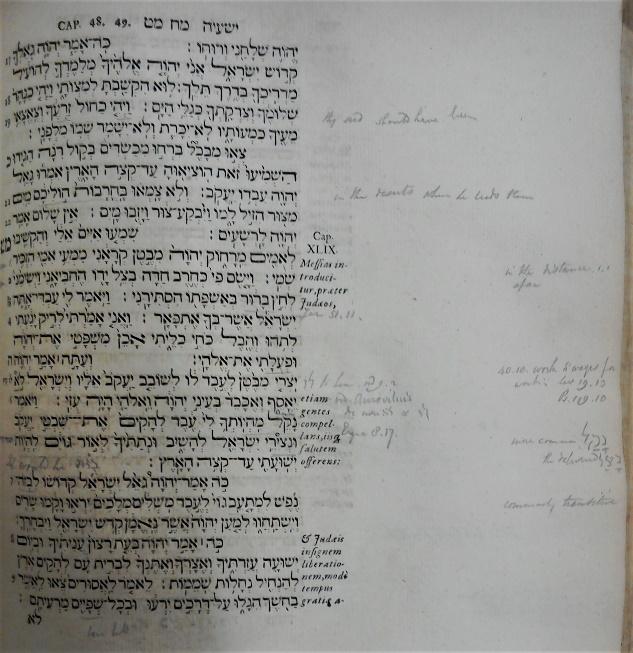
Hebrew with annotations SC 27-6-3-16-01
The Oxford Movement was as much an intellectual movement as one of spiritual revival and Robert was regarded as one of the Movement’s greatest theologians; his good friend and spiritual confidante Henry Manning going so far as to say he was perhaps the greatest of his generation.[7] To be able to see into the minds of history’s great thinkers is a privilege not always obtainable, however thanks to the discovery of a collection of texts once belonging to Robert Wilberforce within the Mirfield Collection, there is a chance we are able to do just that. What first appeared to be a collection of (not unsurprisingly) religious texts ranging in language from English to Latin, German and even Hebrew, upon closer inspection emerged as being that and so much more besides. Not only does the range of languages correspond with what is already known of Robert’s command of Christian doctrine, his familiarity with theological debates in Europe and interest in Lutheran doctrines in particular; the actual content of these texts and the evidence of Robert’s personal interaction with them is most illuminating of all. Through examining these texts it is easy to see more clearly just how consumed Robert was with what he perceived to be the untenable position of the English Church, the questioning of his own religious views as a result of that, and the influence on his own contributions to the history of Christian theology.

Pencil index SC 27-4-2-3-06
The vast majority of these texts are religious in nature, and are altogether an unsurprising collection given they belonged to a man of the Church. However, with the knowledge of Robert’s spiritual doubts and misgivings, when certain texts are examined more closely we find that they become further evidence of this. Many are concerned with the reformation of the liturgy, the administration of the sacraments, and post-reformation histories of similar crises within the Christian church; of the books there a considerable number which contain signs of interaction by Robert such as marginal annotations, underlining and the logging of pertinent sections in his own personal index. For example in A Petition for Peace “highlighted” sections include those relating to the sacraments, specifically communion and the contested idea of transubstantiation; and the greatest example of Robert’s indexing in this sample can be found in Robert’s copy of Paolo Sarpi’s History of the Council of Trent. The Council itself was a key part of the Counter-Reformation, playing a vital role in revitalizing the Roman Catholic Church throughout Europe and though Sarpi was critical of the Council for hardening differences with Protestants and quashing any hope of a united Christendom, it seems that this text is one which Robert engaged with heavily, and may be cited as an influence on Robert’s own writing.[8] Within this text indicated in the margins are sections such as those concerning ‘indulgences’, ‘repentance’, ‘benefits of council’ and, rather tellingly, ‘church authority’, all of which correspond to his three page index. It might well be assumed that this was a text that Robert found himself going back to time and again, hence the need to make relevant information easy to locate.
Like many of his Oxford fellows, Robert’s main preoccupations were: the centrality of the sacraments; the conviction that the Church of England must be freed from all state interference in matters of doctrine; and the need within the church for a systematic corpus of theology – preoccupying him to the point that his three great works - or doctrines - The Doctrine of the Incarnation (1848), of Holy Baptism (1849) and of the Holy Eucharist (1853), saw him draw together the various strands of sacramental teaching, as communicated and understood both in the past and in more recent times, to form a single corpus of theology. These doctrines are at the heart of why Robert was regarded as one of the greatest theologians of his time or, alternatively, a heretic. [9]
Robert’s works excited such controversy that he was at risk of prosecution by his Archbishop for false teaching. [10] In An appeal to the Lord Archbishop of York, one James Taylor accused Robert of “teaching most emphatically […] all the gross heresies of the apostate Church of Rome”, “advocating without any disguise, all the popery of Trent” in his defence of the decrees of the Council of Trent against those of the Church of England.[11] In fact, Robert rather welcomed an eventuality - namely the threat of prosecution – which would force him to make a decision on the issue that was haunting him day and night – the question of whether he should seek reception into the Roman Church. When in the summer of 1854 rumours began to spread of legal proceedings being initiated against him Robert’s mind was made up, on the 30 August he recalled his subscription to the Oath of Supremacy and submitted his resignation from all his posts to the Archbishop and in October made the trip to Paris where he was to be received into the Church of Rome on all Saints’ Eve. [12]

References
[1] Information available at Wilberforce House Museum
[2] Conrad, B. ‘The Politics of Conversion - the case of Robert Isaac Wilberforce’, International Journal for the
Study of the Christian Church, 16:3, (2016), 182, https://doi.org/10.1080/1474225X.2016.1221591 
[3] Newsome, D. The Parting of Friends: A study of the Wilberforces and Henry Manning,
(London: Murray, 1966), 371 and Nockles, P.B. ‘The Oxford Movement and Evangelicalism: Parallels and
Contrasts in Two Nineteenth-Century Movements of Religious Revival’ in R. Webster, Perfecting Perfection:
Essays in Honour of Henry D. Rack, (James Clark  & Co Ltd, 2015), 243
https://www.jstor.org/stable/j.ctt1dfnrbh.16 
[4] Nockles, ‘The Oxford Movement and Evangelicalism’, 236
[5] Nockles, ‘The Oxford Movement and Evangelicalism’, 258
[6] Conrad, ‘The Politics of Conversion’, 192
[7] Nockles, ‘The Oxford Movement and Evangelicalism’, 256 and Newsome, The Parting of Friends, 381
[8] See ‘Council of Trent’, Encyclopaedia Britannica, https://www.britannica.com/event/Council-of-Trent
and Cronin, V. ‘Paolo Sarpi’, Encyclopaedia Britannica,
https://www.britannica.com/biography/Paolo-Sarpi#ref243329
[9] Newsome, D. ‘Wilberforce, Robert Isaac (1802-1857)’, OxfordDNB, 23 Sept, 2004,
http://www.oxforddnb.com/view/10.1093/ref:odnb/9780198614128.001.0001/odnb-9780198614128-e-29384;jsessionid=A5F5FD7A1615565ED58C1D17686D3610
and Newsome, The Parting of Friends
[10] Newsome, The Parting of Friends, 399
[11] James, T, An Appeal to the Lord Archbishop of York, on the uncondemned heresies of the Venerable
Archdeacon Wilberforce’s book, entitled ‘The doctrine of the Holy Eucharist’, (London, William and Macintosh;
Wakefield, Stanfield, 1854)
[12] Newsome, The Parting of Friends, 402