Showing posts with label University of York. Show all posts

Wednesday, 5 July 2023

Student Curation Project: Unveiling Eastern Europe

Student Curator Ania Kaczynska is working on building an Eastern European Collection for the University Library. Here they outline their background and introduce the project. (Ania is one of two Student Curators we have working with us at the moment; read about the other curation project happening at the same time, here.

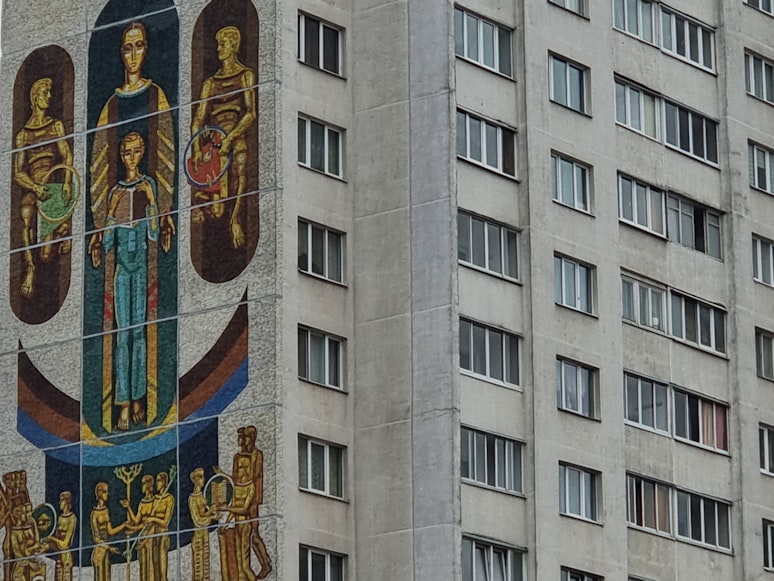
Soviet tall building with a mural on the side of it
Vladimir Malyavko, Minsk. Belarus, 2023. Photo via UnSplash.


As an Eastern European immigrant in the United Kingdom, I quickly discovered that my identity and experiences were not adequately reflected in the spaces I encountered, despite the sizable population of approximately 2.2 million Eastern European nationals residing here. This personal struggle ignited a desire to change the narrative and create a platform where Eastern Europeans can feel acknowledged, understood, and honoured. Today, I am excited to introduce a project that aims to curate an Eastern European Library Collection,  fostering diversity within the library and empowering individuals from the region. 

When I first arrived in the UK, I encountered a distinct lack of representation and understanding of Eastern European culture, history, and perspectives. I yearned for a connection to my roots, a space where I could explore the richness of Eastern European heritage, and a platform that recognised the contributions of our communities. This personal struggle has driven me to initiate a project that not only addresses the underrepresentation but also aims to create a lasting impact on how Eastern Europeans are perceived and valued in Western Europe.

The curatorial project I'm undertaking, titled Unveiling Eastern Europe: Narratives, Politics, and Cultural Expressions, seeks to challenge stereotypes, dismantle biases, and promote inclusivity by curating a diverse range of materials that highlight the multifaceted nature of Eastern Europe. From literature to history, art, politics, and beyond, this collection will capture the essence of our diverse communities, providing a space for exploration, learning, and celebration.

Central to this project is the intention to amplify marginalised voices within the Eastern European diaspora. Through the collection, we aim to provide a platform for individuals from various backgrounds, including LGBTQ+ individuals, ethnic minorities, and other marginalised communities, to share their stories and experiences. By doing so, I hope to foster a sense of empowerment, representation, and solidarity among Eastern Europeans living in the UK.

The Eastern European Library Collection will not only serve as a resource for the Eastern European community but also as an invitation for cultural exchange and mutual understanding. By engaging with this collection, readers from all backgrounds will have the opportunity to explore the rich tapestry of Eastern European heritage, challenge their preconceptions, and foster empathy and appreciation.

I believe that together we can build bridges of understanding, celebrate diversity, and create a more inclusive and interconnected society. Unveiling Eastern Europe: Narratives, Politics, and Cultural Expressions is a call to action, an invitation for everyone to participate, learn, and grow. It is driven by my personal experiences and aspirations, but I primarily aim to create a lasting legacy of inclusivity and celebration. My goal is to bring Eastern European narratives to the forefront, challenge stereotypes, and foster a greater sense of understanding and appreciation for the diverse cultures and perspectives that Eastern Europe has to offer. 


Friday, 22 April 2016

Space Apps working with IT Services

Pedro Ribeiro of Computer Science writes about live-streaming at the Space Apps Challenge.


This year is the fifth edition of NASA's International Space Apps Challenge. For the fourth time the local event, on Saturday 23 April, is being hosted by the Department of Computer Science at York. We expect up to 60 attendees to sign-up, making this the biggest edition of the Challenge at York. Attendees form teams and collaborate with other locations and or virtual participants all across the globe. On Sunday 24th April, teams present their solutions to our panel of academics and industrial representatives, with the winning teams receiving prizes locally, but also competing globally with other locations. The global winners get a chance to attend a NASA launch.

Traditionally, locations have been encouraged to live-stream from their sites, so that people all over the world can get a feeling for what it is like to compete at each location during the weekend. York is no exception, and so we have live-streamed our event every year and published recordings of every team presentation on our YouTube channel. The facilities provided by YouTube to do live streaming are fantastic and accessible to everyone. Here at York we have, year after year, improved on our solution, starting with standard webcams, and ending with a multi-cam Raspberry Pi-powered solution.

An excerpt from last year's live stream:


We are very grateful that this year IT Services have offered to supply us with a dedicated 8-core virtual machine to accommodate our video mixer and live streaming solution. Essentially our set-up consists of Raspberry Pi cameras streaming H264 (encoded in hardware) to a local server, where we can conveniently decode the stream, overlay additional text and graphics, and re-encode it in a format suitable for YouTube. This year we are aiming to have a fully fledged streaming capability by having a live video mixer hosted on the IT Services-provided VM. This is something that can only be successfully achieved by allocating dedicated resources to the task. The video mixing software we use is called Snowmix (with an underlying dependency on gstreamer) and has originally been developed by Copenhagen Suborbitals, an amateur space agency, who specifically developed this piece of software to cover their rocket launches.

We plan to start our live-stream on Saturday morning (23 April), provided everything goes according to the plan. Much testing has been done over the last few weeks, but of course, in the spirit of a hackathon we are also raising the bar for ourselves and trying new ideas.

If you would like to join the Challenge at York you can do so by registering at:


The event is free, but the number of places is limited, so hurry!

You can follow us on Twitter @SpaceAppsYork or at facebook.com/SpaceAppsYork, and of course you can watch the live stream at the link below once the event is underway:


Friday, 19 September 2014

Happy 20th birthday to YorkWeb!

Mike Brudenell looks back to the birth of the University website...


It's 11:55am on Monday, 19 September 1994. Several members of the Computing Service are gathered in our D/104 high performance workstation room in Derwent College, anxiously looking at our watches. Radio York said they'd be here for noon but there's still no sign…

We're about to launch the University's first ever website: the culmination of an accidental discovery and a year of hard work.


I joined the Systems Group within the Computing Service (now IT Services) in July 1988. The following year, our group were lucky enough to receive money from our departmental Innovation Fund to buy a computer, write some software, and create our Information Server. Recognising how useful it would be for people to see information and reference material online, we’d put in a bid to devise something to meet this need.


Computing, sometime in the '80s...
Over the next five years the Information Server was expanded as more and more departments started putting their reading lists, academic and administrative information onto it so they could be viewed 24 hours a day from anywhere on campus.

One of my own responsibilities was to keep an eye on mailing lists and newsletters to look for new technologies that might be of interest. And so, in late 1993, I spotted an interesting article describing work by Tim Berners-Lee: something called the 'World Wide Web', and along with it the first ever graphical 'web browser'.

Curious as to what this might be I had downloaded, built and played with the software and was fascinated: it let you organise and view information much like our own Information Server, but in a much more usable and easy to browse way. You could even include pictures, change fonts and colours. Wow!

I showed my mini test website to the Head of Systems, Dave Atkin, who recognised its potential. So we started planning to retire the Information Server and move all of its content over to this new-fangled Web-thing.

I was charged with setting up the web server software and storage that would hold all the information, whilst Dave wrote conversion programs to extract the menus and pages of data out of the Information Server and convert them into the HTML markup language used for the Web. He even managed to maintain the organisation of all the data, creating index pages corresponding to each of the Information Server’s selection menus.

The Birth of YorkWeb

The University's new website was to be called 'YorkWeb' and, as the new Academic Year fast approached, its launch was set for 19 September. We planned a small event to celebrate, there in D/104, with the Great and the Good of the University (and cheesy nibbles too!).

This was a big thing: there were very few websites in the whole world, let alone the UK! And ours would be unusual in containing lots of information right from Day One, thanks to our prior use of our Information Server.

Somehow the local Press and Radio York heard about the event and Radio York told us they wanted to cover the launch and would be there for noon.


John Byrne (left) talks to radio York.
Our author is lurking in the background (right)
11:56am …
11:57am …

Sudden commotion downstairs! A Radio York radio car screeched to a halt outside and a reporter came hurtling up the stairs, dragging a vastly long training cable behind him! He clipped on the microphone, adjusted his headphones, and smoothly launched into describing the scene to listeners. From his voice they’d never have guessed his mad flight up the stairwell and the cable dangling precariously down through the atrium!


At noon my colleague back in the department threw the metaphorical switch and YorkWeb, with the University's first ever home page, sprang into life. 


From left: Dave Atkin, Anne Worden, Mike Brudenell, Julian Richards.

As the years have passed web servers, web browsers and websites have become ever more capable. Way back at the start every page had a grey background: there wasn't a way of changing it. There were no animations, no embeddable fancy fonts, no way of wrapping text around a photo… and no advertising, no pop-up windows, no browser hijacking malware to take you to dodgy compromised websites!

As new features have been introduced to the Web so the design and content on web pages have evolved. The grey backgrounds are long-gone, and information is now organised not in an "aren't we clever having a website? Here are some links to take you to other companies' sites" but instead to draw you in - helping you to find the information you want, but also keeping you within the site.

Our own University home page has changed and evolved over the years too. Although that first web page sadly no longer exists it is possible to view many from 1997 onwards at the Internet Wayback Machine: a website devoted to taking snapshots of websites over the years. You can use it to view our homepage as the years go by:


And back to today…

So now, on 19 September 2014, we can take a moment to look back and remember. As part of its growing up, the University's website may have been renamed back in 2010 but, having been there at its birth, I'm afraid I’ll always think of it with its original name - so...


Happy 20th Birthday, YorkWeb!

And may you have many more of them.

Monday, 30 June 2014

How I fixed the Library bridge

The Camera Guy
Detail from Google Street View. Copyright 2014 Google.
Max Spicer sets the Google Maps world to rights.

You may have seen that Google recently added Street View photos for both of the University's campuses. As you can't just drive around in a car, they sent someone with a camera on their back to walk around the many paths that weave around our beautiful grounds. You can now explore the campuses without having to get off the sofa and you can even find the guy with the camera if you look hard enough!

This is great for seeing what stuff looks like and, let's be honest, spending hours trying to find if anyone you know got caught on camera. However, Google Maps can do much more. You've probably already used Google to get directions - maybe to work out how to drive to the University - but did you know you can also use it to work out your walking route around campus once you get there? Google's got our roads and paths mapped out, so it can tell you the best way to walk between Central Hall and The Ron Cooke Hub as well as showing you what it will look like when you get there.

This is really useful, especially if you're new to the University, but when I tried out walking directions on Google Maps a few weeks ago, I was surprised to find that Google didn't know about the Library bridge. You could clearly see the bridge on Street View and in the satellite photos, but on the map itself it simply wasn't there. This meant Google's directions were hopeless. You can get between the Library and Market Square in about a minute on foot, but Google sent you off along paths and roads in completely the wrong direction.

Report a problem
Detail from Google Street View. Copyright 2014 Google.
That's not a problem any more, and I'm the one that fixed it. Google Maps now has the Library bridge, and I made sure that it got there. So, how did I do this? Simple - I clicked a link. At the bottom right of Google Maps there's a Report a problem link. I clicked this, then followed a couple of easy steps to say what was missing. Less than a week later, I got an email from Google saying "you were right!" and the maps were fixed.

There are actually quite a few bits of the campus paths that aren't right on Google Maps, or buildings with the wrong name, but it really is easy and quick to get them fixed and doing so will make Google Maps a great tool to help people find their way around the University. Have a look at the maps of campus and if you see anything wrong or missing, click that Report a problem link!
The Library Bridge - now on Google Maps
Edited detail from Google Street View. Copyright 2014 Google

PS: Behind the scenes, there's a great tool called Google Map Maker that lets you make changes to maps by hand. When you click Report a problem, the problems mostly get submitted to this tool and are reviewed and fixed by members of the community. Anyone can get involved, but that's probably the subject of another blog post.

Wednesday, 7 May 2014

Telling Tales

Photo: Stonegate Night bw by Ravensthorpe.
Reproduced under a Creative Commons licence.

Back in the 1980s student life at the University of York was uninterrupted by social media. The internet was in its infancy and computer science students booked their hour-long sessions in the computer block just down from the Library (where we searched for books on microfiche). For entertainment, there were TV sets in the common rooms. We hunkered down in front of The Young Ones and had all-night horror movie sessions, mesmerised by the special effects in American Werewolf in London. The JB Morrell was closed on Sundays. Some of us (whisper it) read books for fun. We read alone. We didn't talk about it. There were no book clubs, nor did we spend much time recommending to our friends. It wouldn't occur to us to do so.

Tales of the City was just six years old when first I discovered a copy in Godfreys bookshop in Stonegate. A story of a naive young assistant moving from sleepy Cleveland to wide awake, loud and colourful San Francisco was the peak of exotic adventure to a student from North Yorkshire. The girl on the (cord) phone on the cover looked so glamorous. Standing at the back of the shop I read 25 pages (to 'Edgar blows up') and that was it. Hooked. 60p a paperback. In the days when we extracted five pound notes from the cash points in Heslington to last a whole weekend, this purchase was a little luxury.

I loved Mary Ann Singleton. She was embarking on a whole new life adventure. (In later episodes, when Maupin turned his sharp pen to harden her character, I am momentarily saddened, but for now she was the girl I wanted to be.) After the weekend, I headed back into town, back to Godfreys to discover there were sequels - More Tales of the City, Further Tales of the City and one, deliciously entitled Babycakes. I read and reread, tracing every nuance, every development, laughing and weeping, but all alone. It never crossed my mind to share my love of these books. We just didn't, then.

Glide forward seven years and there I am, standing at the airport arrivals hall, holding my copy of Maybe the Moon. Feeling a little nervous, a little excited.

Alison Claire Barrow was twenty-one years old when quietly she discovered Armistead Maupin for the first time. Seven years later she is meeting him at Heathrow to accompany him on his UK book tour. Twenty nine years later (pinch me, where did that time go?) she is his long-term UK publicist and proudly out there and loud about it in this, her first ever blog, in the media, in events - and relentlessly on social media. How lucky am I? And still, in my head, sometimes I'm the girl back in Derwent College, flat out on the thin mattress of my bed on the second floor of A block, lit by the angle poise, reading and discovering Barbary Lane for the first time.

Alison Barrow
Director of Media Relations
Transworld Publishers