Tuesday, 10 April 2018

Your feedback is important to us

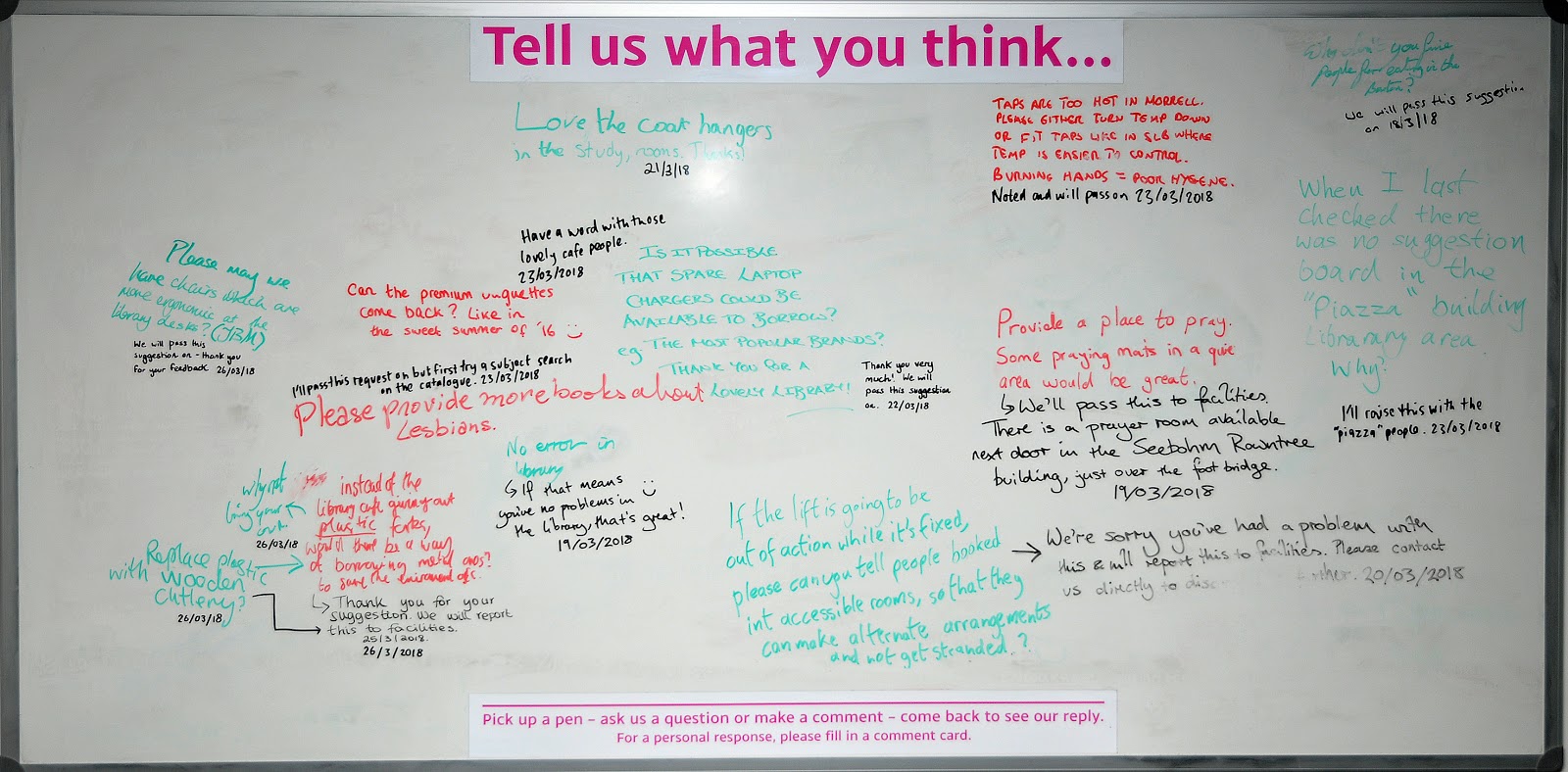
We have a strong customer service culture and strive to increase customer satisfaction. We use your feedback to improve our service delivery by really getting to know your needs and expectations. As current holders of the Customer Service Excellence Award with compliance plus in 13 of the criteria, we monitor and review our processes as part of continuous improvement. Your feedback provides us with key information about what you think as a user of our services and helps us make informed decisions about improvements; it also helps us identify area where we are doing a good job.

What happens when you provide feedback?

There is a Departmental strategy in place to monitor and respond to feedback suggestions. We collate all of the feedback into a report which is presented to managers meetings for review on a monthly basis where we look for themes, explore ideas and discuss solutions to problems identified. Please do add your contact details when providing feedback, that way we can respond to your directly.

What do we do with your feedback?

If we can implement a change or improvement based on your feedback we will. If however we can’t, we will explain to you the reasons why.

Here’s a summary of what has happened as a result of your feedback during Autumn 2017
  • Standing desks have been purchased and are now available on the 1st floor of the Morrell Library
  • We have provided student kitchen facilities on the 1st Floor of the Harry Fairhurst building
  • YorSearch has been updated to include the shelf mark in the search results screen
  • New welcome emails are now sent to new PhD students, telling them about Library Services
  • Improvements have been made to the wifi access in the Harry Fairhurst building
  • A new accessible study room is now available in the Harry Fairhurst building
  • We are in discussions with our colleagues in Estates about the varying temperatures across our buildings
Please continue to pass on your ideas about how we can make improvements. Further details of how to submit feedback is available on our web pages or you can simply pop in and speak to someone in person at the Helpdesk based in the Library and Kings Manor Library, or add a comment to our whiteboard in the Foyer of the Morrell building.
Friday, 6 April 2018

"Rare Books and Religious History - discovering the Mirfield Collection" a blog by Marios Antoniou, Intern for the Institute for the Public Understanding of the Past

Photo by author
Before I started my placement at the Library of the University of York, I only had a vague knowledge of the Oxford Movement in the Anglican Church and had never heard of the Community of the Resurrection. The purpose of the placement was to add information for the Rare Books Collection webpages in order to promote the Mirfield Collection to a broader non-academic audience. Before I talk more about the collection I want to provide some context. 

The Oxford Movement began between 1833 and 1841 when a number of high-profile Anglican Church Leaders issued a series of Publications called ‘Tracts for Our Times’ seeking to reform the Church by rituals associated with the Catholic Church. Tractarianism as it came to be called aroused opposition from Low Church Anglicans who viewed these proposals as stealth Catholicism. Over the 19th century there were numerous conflicts about the role of Ritualism in the Church. Tractarian priests were often not supported by their Bishops and experienced poverty. Many became engaged in social work, living in slums and supporting the poor.

Photo by author
The Community of the Resurrection was founded in Oxford - the epicentre of the Movement - in 1892. The Archives of the Community reveal that the decision to move to Mirfield was taken in 1897 and was driven by a desire to be close to the ‘great industrial centres of the North’. In 1898 the Community of the Resurrection moved from Pusey House, Oxford to Mirfield, West Yorkshire. Out of the first six members of the movement, five were part of the Christian Social Union who were instrumental in fighting poverty. The community was ecumenical and had contacts with religious figures outside the Anglican Church. The Community built a college and had an extensive collection of books which were given to the University of York on a permanent loan - along with the archive - as the Community did not have the facilities to store them. The Rare Books Collection at the University of York contains around 33,000 books and other items. The Mirfield Collection is the largest consisting of approx. 3000 books dating from the 15th century to the 19th century.

During my placement I looked at the Chapter minutes in order to find information about the Community and specifically about the acquisition of the Library. To do so I had to look at 
Photo by author
microfilms in the Borthwick which recorded the Chapter minutes. It was a new experience as I had never seen a microfilm before. Subsequently I looked at a list that had been created showing book owners, and then at the books themselves. Although most of the catalogue records about the books were lacking information about their owners, a recent project in the library had provided provenance details for 242 of them. 15 of these belonged to women. Although the proportion is quite small it still shows evidence of female ownership of books. The great majority of the books in the provenance list, 207 out of 242 were of a religious theme but the collection also contained non-religious books. It contains treasures such as the second edition of Thomas Hobbes' Leviathan (1651), the first edition of A journey to the western islands of Scotland, by Samuel Johnson (1775) and an edition of St. Augustine's De civitate Dei, printed by Nicolas Jenson in Venice (1475). 

Photo by author
About half of the 242 provenance project books (118) are in English while 100 are in Latin and the rest in various European languages such as French and Italian. Although the text of most of these books is available online it is a worthwhile experience to spend time at the Borthwick Institute of Archives consulting the collection. Looking at a book printed many centuries ago, looking at the binding, the font and even smelling the pages is an exhilarating experience.

To arrange to view an item in the Rare Books Collection, please contact the Borthwick Institute

Tuesday, 3 April 2018

“Mortal remains: life, death and the medical community of York in the early nineteenth century”


Ruth Elder (Collections Management Specialist) writes ... One of the pleasures of working in the University of York library is the opportunity to explore our historic library and archive collections. Items are by necessity labelled as attached to distinct collections (within the limits of the buildings and catalogues). The University of York is fortunate to hold a rich range of local medical collections including those of the Retreat, York Health Archives, and York Medical Society. What individual collections can sometimes fail to reveal explicitly is the complex web of relationships and narratives which link across the collections. Such relationships have become apparent to me as I have delved into the history of York County Hospital Medical Library (YCHML).

The hospital opened in 1740 on Monkgate, before moving to a site adjacent to Monk Bar in 1746, leading to the eventual opening of a Medical Library in 1810. Research into the history and development of the Hospital Library suggests that it grew and expanded in parallel to the development of an increasingly organised and formalised medical community in York.

In February 1832 a number of physicians and surgeons became founder members of the York Medical Society which was conceived as a space for the purpose of “promoting and diffusing medical knowledge”; a philosophy which the Society retains to the present day. From its inception, the Medical Society took an active role in the affairs of York’s key medical institutions, particularly the County Hospital. In addition it was involved in the management of the Medical Library, working to enhance the Library’s value as an educational resource and depositing books at its own expense.

Hospital, 1830.  Photograph by Paul Shields
York Minster Library holds what appears to be the only surviving copy of any YCHML catalogue and this has provided a valuable resource from which to identify the extent of the surviving holdings of the Medical Library as listed in 1830.


Original in the Borthwick Institute,  University of York, RET/8/6 under
Creative Commons licence (CC-BY-NC)
As I searched for information associated with YCHML I stumbled (digitally) across the “Table of Mortality” shown here. Minutes of York Medical Society record that on 1st February 1840 a Quaker surgeon suggested publishing weekly returns of deaths and their causes in York, with the objective of advancing knowledge and medical science. The York Superintendent Registrar agreed to supply information and weekly reports were placed for consultation in the Reading Room of the Medical Library, and in the council room of the Yorkshire Museum.

This copy of the form has been adapted to give totals for the year ending 1st January 1841, listing causes of death in York and the surrounding areas (broken down by age group.) The vulnerability of child health at this time is reflected in the single greatest cause of death reported as Scarlatina (Scarlet Fever), with 187 of the 192 fatalities occurring in children. Convulsions proved fatal for 132 children. Consumption (Tuberculosis) was the main cause of death in adults (134), with 146 reported to have had the good fortune to survive past 60 before yielding to a death of “Old age or Natural Decay”.

The Mortality table (preserved within the Retreat Collection), was initiated by members of the York Medical Society, who were instrumental in both the growth and preservation of the YCHML. The 667 book titles listed in the 1830 YCHML catalogue reflects resources available to the local medical community in York as they confronted the range of illnesses and conditions endured by the local community. In association with the Mortality Table, the Medical Library gives an engaging and colourful insight to the historical, social and cultural understanding of illness and health in York in the early nineteenth century.
Title page of Eight chirurgical treatises.  
Photograph by Paul Shields

Of the 667 titles listed in the 1830 catalogue, 568 have now been identified as held in the York Medical Society collection, which is now maintained within the University of York Library Rare Books collection. An exhibition titled “Buried treasure: rediscovering the York County Hospital Medical Library” is on display in the Harry Fairhurst corridor at the University of York Library between 3rd April - 30th June, and all of the collections mentioned are available for consultation through the University of York Library and Archives.

To arrange to view an item in the Rare Books Collection, please contact the Borthwick Institute

Tuesday, 20 March 2018

The #BigAlumniProject - vote now!

By Ned Potter, Academic Liaison Librarian

We're very excited to be in the final of The Big Alumni Project, currently being decided by a vote. If you're not familiar with this, it a new YuFund supported scheme for this year, providing one student or staff project with an amazing £40,000 grant to make a lasting change to the campus and community. It's funded by donations from York alumni and friends of the University.

First there 26 projects, then that went down to six, and the final shortlist now stands at three. Here's an overview of our proposal:


It is a complete re-imagining of the Morrell Lounge into an absolutely spectacular space, which better suits the way in which students and staff currently use it. It would involve not just amazing furniture but acoustic treatment as well to contain the noise, plus places to charge devices and a lot of flexible seating.

Below are a couple of 3D views of our proposed design:

The design features high-backed furniture and a 'fabricks' wall to absorb some of the noise
As well as a central seating / working area, there are tables and chairs that can be moved around to wherever suits

This isn't something we want to do on a whim, this is part of big project known internally as UX Space. We've been observing the Morrell Lounge for a year, using a technique known as Behavioural Mapping, and we've concluded that the way we'd set up the space didn't suit the way you were using it at all.  You often cluster together, sometimes sitting on the floor, because the sofas and chairs aren't suited for groups. We changed the space a little on December (the tables and low sofas came in) and that got really good feedback. But this would be a complete re-imagining into something that looks amazing for students, staff and visitors, and works exactly as you need it to. This is perhaps THE busiest space on campus, open 24 hours a day for 362 days a year, with 3,000 people passing through the lobby each day on average, rising to 7,000 at peak times. So it has to work.

The images in this post are based on the design we've come up with to solve all the problems we identified in the UX research, but we'd work with students and staff to finalise it if we we win. Here are a couple more views of the proposal:

The high-grade furniture is if the same type found in the new Piazza Building on Hes East 

There will be powered furniture, allowing you to plug in and charge devices while you work 
We hope as many people as possible will vote, for whichever idea they'd most like to see happen. Whether you're a student, member of staff, alumnus or member of the public, you can find the links to vote on the Big Alumni Project landing page - voting closes at the end of March.

Finally, here's a brief video overview of the whole project...


Monday, 12 March 2018

Role of Women in the Indian Independence Movement

By Alex Jubb


The current exhibition in the cases in the Harry Fairhurst corridor at the University of York Library tells the story of the road to Indian independence. The exhibition uses books and archives from the university’s collections and themes include the relationship between coloniser and colonised, and Indian literature.  Highlights include a telegram from Gandhi, and books that belonged to former Prime Minister Clement Attlee. The exhibition will remain in the cases until the end of March 2018.

Alex Jubb worked on the India project as an intern in 2017 and has written several blogs (Aug 2017#1)(Aug 2017#2)(Jan 2018) (Feb 2018) about the collection and the history of the Independence movement. Here he examines the role women played in the Indian Independence.

Role of women in the Indian Independence Movement


An often-untold story of the Indian independence movement is that of the role of influential Indian women; whilst stories of Gandhi, the nationalist writer Raja Rao and other important male political and cultural figureheads are commonplace, members of the opposite gender are rarely taught about in the history of Indian independence. Indian women were not only working to gain independence for their nation, but were seeking enfranchisement and political representation in the local, national, and international spheres. It is clear that one of the most important aspects of the movement for independence from a historical point of view is that it saw mass participation by women; women who had till then been confined to the domestic sphere. 


Crucial figures of the Quit India Movement. Image courtesy of  Quirkybyte.
https://www.quirkybyte.com/blog/2016/08/6-unsung-heroines-independence/
Women were involved in diverse nationalist activities, both within and outside the home. Within the home women held classes to educate other women and contributed significantly to nationalist literature in the form of articles, poems and propaganda material. Moreover, shelter and nursing care were also provided to nationalist leaders who were in hiding from the British authorities. Furthermore, and most importantly, when the nationalist leadership were in jail, the women took over the leadership roles and provided guidance to the movement. The JB Morrell Library at the University of York holds many important works written by leading female members of the Indian nationalist movement, in addition to works from Indian women from every class in society.


Anans and Hutheesing's 1949 work. © amazon.co.uk
Female nationalist authors did not let up in their campaign for further empowerment following the granting of independence. The Brides Book of Beauty, written by Mulk Raj Anand and Krishna Nehru Hutheesing, was published in Bombay in 1947. The work served almost as an anthological manual on feminine sensibilities, formulas of female beauty, and female social experience. One critic described the work as the manifestation of Anands affinities with Marxist utopian notions of egalitarian civilisation and womens empowerment. The authors developed a perception of Indian female beauty that was adorned with poetry, prose, folktales and myths. [There is a copy in the exhibition]. It was clear that Anand and Hutheesing saw independence as a springboard with which to further the rights of Indian women. Using the very same myths and folklore that were crucial to creating a nationalist fervour prior to independence in 1947 was essential to Anand and Hutheesings writings.

Nanda's seminal work. ©amazon.co.uk
Savitri Devi Nanda was the author of The City of Two Gateways: The Autobiography of an Indian Girl; Nanda writes every detail of her early life in a typical Hindu aristocratic family of the pre-partition Punjab. This is an important work that brings to life the beliefs of many young Indian women both before and after partition. For example, Nanda writes that one night her father took her to Lahore to put her in a school; neither her mother nor her grandmother was in favour of educating her. It was this thirst for freedom and knowledge that was encountered in the young female nationalists and marked a distinct difference and a remarkable gulf between this generation and the previous generations before them. Where Nanda excels is in describing her sense of loss or separation; this stemmed directly from her strong awareness that she was an active participant to the exciting events of the national struggle for freedom.