Showing posts with label open research. Show all posts

Tuesday, 24 January 2023

Retaining rights to make publications open access: the N8 partnership approach

Jonathan Cook is Open Research Project Officer based in Library, Archives & Learning Services. In this post, he looks at the significant collaborative approach to open access publishing announced by the N8 Research Partnership, and how it will impact York researchers and policy.

Image of an open padlock on a laptop
Photo: Lock on laptop, Rawpixel www.rawpixel.com/image/5908216
reproduced under a Creative Commons CC0 licence 

The N8 Research Partnership, of which York is a member, today released details of a collaborative approach aimed at strengthening and harmonising Open Access policies across eight of the leading universities in northern England. This new initiative aims to empower researchers to make their work openly available immediately on publication, removing current barriers to dissemination and streamlining an often complicated process. 

The N8 approach revolves around “Rights Retention”. In basic terms this is a recognition that authors should have certain rights over the research publications that they have created. In the past, researchers have typically been required to relinquish all rights to their research when signing contracts with publishers. This means they are left with limited ability to share their work. The University believes that open research practice enables a wide range of audiences to freely discover and engage with its excellent research, makes the research process transparent, and creates new opportunities for outputs and methods to be reused, reproduced and credited. If authors cannot exercise the rights to their research, and do not feel empowered to make their work open, these benefits become much harder to achieve.

This in turn can make it difficult for researchers to comply with Open Access requirements set by research funders. For instance, UKRI – the largest funding body in the UK – requires its authors to make their works openly accessible upon publication. This is often not possible in the current ecosystem, where publishers can place access embargoes on all versions of a paper, meaning the research may not be available until months or even years later.

Plan S logo
Plan S logo, © Coalition S
Rights Retention in an Open Access context was first endorsed by faculty at the University of Harvard in 2008 and it has been the basis for many subsequent Open Access policies in the US, and more recently in the UK. In early 2022, the University of Edinburgh became the first UK institution to adopt a Rights Retention policy, with Cambridge and St Andrews among the universities that have since moved to this approach. Rights Retention is also the first principle of Plan S, the Europe-wide initiative towards greater open-access. As many of the largest research funders in Europe are members of Plan S, Rights Retention principles are also likely to be endorsed by a growing number of institutions on the continent. 

In the N8 approach, the researcher grants their university a non-exclusive licence to make the peer-reviewed Accepted Manuscript version of a research article immediately and publicly available as soon as the final version is published in a journal. This licence then has precedence over any agreement subsequently made with the publisher. A Rights Retention model simply recognises and reinforces the rights that an author should hold over their own work. The journal publisher retains their right to charge for access to the final published, typeset version of the work, ensuring that all parties remain recompensed for their valuable input.


N8 Research Partnership logo
N8 logo. © N8 Research Partnership

Rights Retention will make it easier for researchers to make their work openly available and enjoy the benefits associated with open research. By continuing to deposit manuscripts to the York Research Database, authors can be confident that this is sufficient to comply with funder requirements, as well as meeting likely eligibility criteria for future Research Excellence Framework exercises. This is a positive move, from a situation where the responsibility fell on the individual researcher to make sense of the complex OA requirements of their particular case, to an environment where the University takes leadership in facilitating the open sharing of its research. 

The N8 Universities will now be implementing these principles. Leeds, Newcastle and Sheffield have already announced their new Rights Retention policies.  

More information about how this approach will affect Open Access policy at the University of York, along with guidance for researchers at York, will be available soon.

Friday, 2 September 2022

My Introduction to Open Research Practices and Principles

Kate Smith recently worked as a Project Coordinator Intern for the Open Research team where she helped to create a strategic skills framework for open research practice. In this blog post, Kate reflects upon the important role of open research values, principles and culture at the University of York.

What is Open Research?

Open research embodies the idea that all aspects of the research cycle should be as open as possible, as closed as necessary. When I first joined the Open Research team, my knowledge and experience in open research practice was very much limited. However, I was attracted to the opportunity because I was eager to learn more about how open research can benefit an increasingly complex and digital world. 

My initial exploration into open research was focused on the history of knowledge-sharing and how this has transformed research as we know it today. The practice of open publication and knowledge sharing was first established in the 1990s with the widespread availability of Internet access. Here, it was possible for researchers to publish their own work and also make it instantly accessible anywhere in the world. The first online, free-access journals emerged at a time when the traditional, print-based journal system was in crisis. Today, there are more than 12,000 academic journals available to researchers to publish and share their work. 

In a post-COVID climate, scholarly attention is now focused on the need to make research a more open and collaborative process. Open research, also known as open science or open scholarship, is practised and supported by those who want to further the potential of digital technologies in scholarly communication.


Projector display screen in the Berrick Saul Treehouse showing the Open Research at York: Two Years On event poster
Photo from the Two Years On event in July

Open Research at York

The Open Research team at the University of York have made tremendous efforts in promoting and supporting an open research community. Their work includes the successful development of an Advocates Network which includes academics, researchers and support staff who are champions of good open research practice. 


During my internship, I had the fantastic opportunity to meet with advocates and fellow practitioners of open research at the Two Years On event. Many of the presenters at this event were recipients of the Open Research Awards scheme which recognises work that encourages dialogue, reflection and border thinking about open research practices. Here, I was introduced to the brilliant work of Caitlin Doley and her colleagues who had created the innovative Aspectus: A Journal for Visual Culture, and Vlad Ungureanu and Dr Andrew Mason’s JBU visualisation tool which demonstrated the massive potential of sustainable software practices in the advancement of biomedical research. 


Open research lifecycle wheel diagram, with four segments labelled Develop, Acquire, Process and Publish
A preview of the open research lifecycle wheel from our forthcoming skills framework

An Open Research Skills Framework

Over the course of my internship, I have learnt about the roles, challenges and benefits of open research for the research community at York. The objective of my internship was to create an inclusive skills framework which outlined the knowledge and skills of open research practices as well as provide information on relevant guidance and support. 

In addition to my own research, I had the opportunity to meet with open research advocates and practitioners who provided critical feedback to my first draft of the skills framework. 

We are aiming to finalise and launch the Open Research Skills Framework in time for the start of the 2022/23 academic year. Follow @UoYOpenRes on Twitter for the latest updates on this and other York Open Research initiatives.

Monday, 4 July 2022

Return of the York Open Research Awards

In this post Ben Catt, Open Research Librarian, announces this year’s York Open Research Awards recipients and shares an invitation to our Two Years On event on Wednesday 13th July.

York Open Research Awards 2022 logo; white and yellow text on purple background with University of York and UKRI Research England logos

As we reach the end of another academic year, we are pleased to announce the recipients of our second round of York Open Research Awards. This University-wide scheme ran during summer term, welcoming projects and initiatives from researchers across all disciplines, levels of study and career stages. 

The criteria and motivations behind the awards were similar to last year (see previous blog post). The purpose of this year’s scheme was, once again, to celebrate innovation, advocacy and good practice in open research whilst addressing and reflecting upon some of the issues and barriers faced by researchers who engage in such practices. What we mean by good open research practice is that different aspects of the research lifecycle are shared and accessible, helping to make the research process transparent and creating new opportunities for outputs and methods to be reused, reproduced and credited. The motive behind running another awards scheme was to continue incentivising and highlighting examples of good practice across the University, helping contribute towards a University research culture where open is seen as the default (see Open Research at York).

The proposal for this year’s awards was developed in collaboration with members of our practitioner-led Open Research Advocates network. As we reflected upon last year, it was important to have their input in the scheme from the outset. We also had an interdisciplinary judging panel which included a representative from each faculty at the University (lecturers from Environment and Geography and Education, the Research Development Manager for the Arts & Humanities) and an ECR rep - a postgraduate researcher from Psychology.

Open for submissions

UKRI Research England logo
Research England logo © 2022 UKRI (source)


Funding for this year’s awards came from a UKRI Research England grant for enhancing research culture. Open research has a key role to play in how research is valued, rewarded and incentivised, and we were successful in securing a share of this grant which has been allocated to the University as a whole to support activities covered by the Government’s R&D People and Culture Strategy. We set aside £200 for each prize, and took the same approach as last year by grouping the awards into categories for each faculty and by type of submission (research projects and advocacy or training initiatives). 

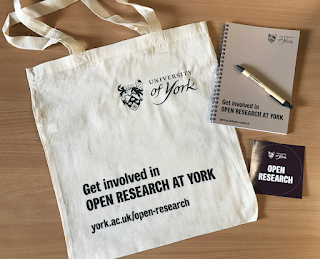
We also commissioned some York Open Research merchandise to help incentivise submissions, which involved some lengthy, but helpful, discussions with our central Communications Support team on the University’s new branding guidelines! We ended up opting for the simplest combination of fonts and colour palettes, and we’re in the process of embedding this new visual identity on our web pages and elsewhere. We purchased "Get involved in Open Research at York" tote bags, notebooks, eco-friendly pens and stickers, which we’ll also be offering at our Two Years On event next week (see below). 

York Open Research merchandise, including a tote bag, pen, notebook and sticker

Submissions were open for four weeks between April and May, during which we received 23 entries across nine departments (an improvement on last year, when we received 15 submissions across eight departments). We’d like to thank all those who submitted their work, as well as members of our Advocates network and others who shared information about the awards in their areas. 

Last year the judges were quite generous and decided that all the submissions were worthy of awards. This year’s submissions were strong, but the panel chose to exercise a bit more discretion and selected just 12 entries for recognition. This included seven from Sciences (mostly Department of Psychology), three from Social Sciences (all from Education) and two from Arts & Humanities. We had a good share of staff, postgraduate researcher and student awardees, including one third year undergraduate in Psychology. There was also a greater share of undergraduate and postgraduate submissions this year than last year, which was good to see.

A full list of awardees is available on our York Open Research wiki space, and in the following tweet thread:

Awardees include a postgraduate researcher-led open access journal in History of Art, open source tools in Biology and Chemistry, and several projects in Education and Psychology where workflows and methods have been shared openly through preregistration and other means. We will be working with our awardees to develop advocacy and training materials based on their work, hopefully including new additions to our series of  Open Research in practice case studies.

Open to ideas

We are keen to hear from members of our research community, including those who participated in this year's awards, with any suggestions on how we might be able to improve the awards scheme if it goes ahead next year.

For instance, we didn’t spend all the funds that had been allocated for prizes as we didn’t have any eligible submissions in certain categories, and the distinction we created between submission types (projects and initiatives) was difficult to determine in some cases. Next year we may reconsider our use of prize categories, taking into account the different levels of awareness and engagement which continue to exist across disciplines, and the need to further encourage open practices in some areas (see previous post on our summer 2020 survey).  

Quite a few submissions included lengthy descriptions of the research topic itself, whereas the judges were just looking for evidence of open research practices and principles in the work. We could perhaps revise the submission form to encourage more focused and relevant submissions. Another reflection is that the awardees announcement came later than planned, and ended up being the same day as the York Graduate Research School 3 Minute Thesis competition and a day before the YUSU Excellence Awards. If we are able to run another awards scheme next year then we should consider the timings more carefully to take account of other events such as these. 

An open invitation

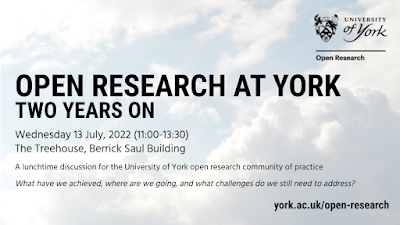
    Open Research at York: Two Years On event poster; black text on cloudy sky background with University of York logo. Text reads: Wednesday 13 July, 2022 (11:00-13:30) The Treehouse, Berrick Saul Building; A lunchtime discussion for the University of York open research community of practice; What have we achieved, where are we going, and what challenges do we still need to address?


This year we have invited all the winners to attend York Open Research: Two Years On, an in-person event scheduled for next Wednesday, 13th July. Three awardees are contributing posters for the event, and four have agreed to do presentations, which should be a good way to share these projects with the wider research community at York. 

This will be a friendly and informal event for staff and postgraduate researchers, reflecting upon what we have achieved in the past two years as an open research community of practice and considering where we are going and what challenges still need to be addressed. The event will be hosted by Professor Sarah Thompson, chair of the University of York Open Research Strategy Group, and will include lunch and refreshments. 

You can find out more and register for the event here if you haven’t already done so. We look forward to being able to meet with our research community in person after two years of online events and Zoom meetings!

Thursday, 25 November 2021

Celebrating open research at York

 In this post Ben Catt, Open Research Librarian, talks about the success of this summer’s York Open Research Awards scheme which highlighted engagement with open research practices and principles across the University. 

Back in September 2020 the University Library submitted a successful bid for a £2,500 grant from Wellcome Trust to help develop an open research community of practice at York. As I explained in a previous blog post, the University is committed to supporting the values, principles and culture of open research whereby all aspects of the research cycle can be shared freely for others to reuse. A key element of this is ensuring that good examples from our research community are shared and celebrated, hopefully inspiring others to consider adopting open methods in their own practice. We decided that an awards scheme would be a great way to achieve this, and we were delighted to receive support for our proposal from Wellcome alongside match funding from the University Research Development Fund.

We can’t take credit for coming up with the idea of an open research awards scheme; University of Reading were probably the first UK institution to run such a scheme in 2019, which they repeated in July this year. Similar prizes have also been awarded by King’s College London, University of Bristol, University of Surrey and most recently our White Rose Libraries partners at University of Sheffield. A useful primer from the UK Reproducibility Network offers advice from awards scheme organisers at some of these institutions, and our initial proposal followed a similar model with the focus on running a high-profile showcase event for the winners.

A shift in focus

Plans for the awards were set aside until summer as we concentrated on other initiatives, including the formation of our Open Research Advocates network and organising two successful Open Research in Practice events; Software Sustainability in Practice and Open Humanities in Practice. We then decided to turn to our research community for their thoughts on our proposal (in hindsight, we should have involved them in our plans at an earlier stage).

Our Advocates network and academic colleagues from the University Open Research Strategy Group provided useful feedback on the need to carefully define the criteria by which submissions should be judged, bearing in mind the difficulty of comparing practices like-for-like and the disparate levels of engagement and issues surrounding open research in different areas (as highlighted by our open research awareness and engagement survey last year). Another suggestion was to focus on encouraging engagement in disciplines where open research is not common practice and to bring about wider benefits to the research community by developing eligible submissions into case studies for training purposes. 

With this feedback in mind we decided to refocus the awards as a less competitive and more inclusive opportunity to highlight projects and advocacy initiatives across disciplines. The idea was to recognise work that encourages dialogue, reflection and broader thinking about some of the issues involved in open research and barriers to its implementation. The prizes (£200 each) were split into categories by faculty and role (staff, postgraduate researchers and undergraduate students), thereby encouraging participation from a wide range of potential entrants. We also decided to set aside some prize money to use as additional funding for selected initiatives at the discretion of the judging panel, which comprised academic staff from each faculty and an ECR (Early Career Researcher) representative from the Strategy Group. 

A simple submission process was devised where we asked entrants to provide a brief description (no more than 1,000 words) of their research project or initiative, focusing on ways in which they have engaged with, reflected upon or advocated for open research practices and principles. They could also provide links to supporting materials, for example open access publications, open data sets or pre-registration documents arising from their work. The submission form was open from May 10th to June 4th and publicised through various channels including our recently-created York Open Research Twitter account.

And the winners are...

Fifteen submissions were received, covering a diverse range of projects and initiatives from across all three faculties and from researchers at different stages of their careers or studies. We received several submissions in some categories, but less entries than we had expected overall. The judging panel agreed to be flexible in how the prizes were distributed, and so we decided that all submissions were deserving of recognition. A full list of the projects and initiatives that were awarded can be found on our York Open Research wiki.

Several submissions were for open research advocacy and training initiatives, and the judging panel decided to award additional funding to two submissions based in Psychology. The first of these is Open Autism Research, a collaborative network encouraging open and reproducible practices in the field of autism research led by Dr Hannah Hobson. The network was launched at an online event in September attended by over 40 delegates from around the world and Hannah took the opportunity to talk about this at our recent Open Access Week showcase event, Open research across the White Rose Universities. The second initiative to receive funding is our local ReproducibiliTea journal club, who meet bi-monthly during term time to discuss diverse issues, papers and ideas about open and reproducible research. The organisers (who are all ECRs) are now planning events to expand their membership and exchange experiences with researchers across other disciplines. We look forward to seeing how both these initiatives develop in the upcoming year!

We are also working with researchers to turn their submissions into Open Research in Practice case studies, another initiative borrowed from the University of Reading. The focus of these case studies is on the experiences of researchers and lessons learned through their engagement with open research practice. The first set of these include Romans at Home, a collaborative outreach project with York Archaeological Trust led by Digital Heritage MSc student Eleanor Drew, and Covid Realities, a participatory research programme with low-income families led by researchers in SPSW. If you are a researcher based at York then we would love to receive your case studies to help inspire others to embed open practices in their work.

What next?

We would like to run the York Open Research Awards again next summer but we are still in a very early stage of planning. We welcome any thoughts from the research community on how the scheme could be improved, or suggestions on how to help incentivise and celebrate open research practice across the University. 

Please feel free to email the Open Research Team (lib-open-research@york.ac.uk) with your ideas and follow us on Twitter for updates on this and other #YorkOpenResearch initiatives.


Tuesday, 5 January 2021

A year in open research at York

Open research enables all aspects of the research cycle to be shared freely for others to reuse. Ben Catt talks about the rise of open research practice during the Covid-19 pandemic, and recent initiatives for open research at York. 

Thursday, 24 October 2019

Open for whom?

The theme of this year's International Open Access Week is 'Open for whom?'. Thom Blake writes about models for achieving open access and how we can ensure equity.

by torange.biz, CC BY 
The economies of scholarly publishing may not be something that most people spend a lot of time thinking about, but whether you need access to resources for your own research, are publishing research yourself, or benefit from the results of research - so, everyone - the effectiveness of scholarly communication systems is important to you. The ever-increasing role of digital technologies in the communication of research has led to many changes and innovations and one of them is an increased emphasis on open access to research outputs; ensuring that they are available to anyone across the globe with an internet connection without financial barriers and with minimal technical and legal barriers. But it’s a shift that needs reflection; how can we be sure that the new models of research communication that emerge don’t replicate the inequalities of previous models, or bring about inequalities of their own? Ensuring equity in Open Access has, in one form or another, been the theme of International Open Access Week for the past two years, but how researchers, libraries, publishers and research funders will work together to shape this ecosystem in a way that is both equitable and sustainable remains to be seen.


The rise of the APC


For many - in the UK at least - open access publishing has become almost synonymous with an article/book processing charge (APC/BPC) model. This is a ‘pay-to-publish’ model where authors, their research funders, or their institutions pay a fee to the publisher in return for their work being published as open access. The 2012 ‘Finch report’ - Accessibility, sustainability, excellence: how to expand access to research publications - set UK national policy firmly in the direction of publication charges as the route for increasing access to publicly funded research.

For the advantages that the APC/BPC model brings, there are drawbacks. There is a risk that an inequality in who can access research outputs is replaced by an inequality in who can afford to publish their work and where. At the University of York we receive funding from a number of research funders to cover the cost of publishing the research they fund - the York Open Access Fund  - but universities, in general, are not in a position to pay publication fees for all of the research done under their auspices. While some researchers are able to reimburse publication costs from research grants, this certainly isn’t the case for everyone. Most open access publishers offer some form of fee assistance or publication charge waiver for those that cannot afford to pay, especially from lower-income countries, but this does feel more like a sticking plaster than a long-term solution.

Hybrid publications initially seemed like a potential solution. In the hybrid model, those that can afford to pay for open access can do so, but those that can’t afford it don’t have to. But with higher publications charges, fear that libraries are being charged twice for the same content ('double-dipping'), a lack of discoverability, and concerns over the long-term effects on the scholarly publishing environment (Rettberg, 2018, The worst of both worlds: Hybrid Open Access) hybrid is out of favour. In Plan S - the new open access policy framework from Science Europe to which UK Research and Innovation is a signatory - hybrid publication are not seen as a viable route to open access. The Wellcome Trust has announced that from 2021 they will no longer support open access in hybrid publications, and other research funders are sure to follow suit. 

Transition?

Open or Closed by Alan Levine, 

What Plan S does support is the ‘transitional agreement’. Under these agreements, support for hybrid publishing can continue as long as an arrangement is in place that provides a route for a journal to ‘flip’ to an open access model within an agreed timescale and for libraries to transition from paying subscriptions to funding open access publication. The most common transitional model emerging is ‘read-and-publish’, in which a single institutional subscription allows members of that institution to access subscription content in a publication, and allows authors affiliated to the institution to publish their own work as open access for no additional cost. On our website we maintain a list of open access memberships available to York researchers.

At a local level, read-and-publish style agreements provide a useful solution to the equity problem; any member of the University can take advantage of the ‘free’ open access publishing irrespective of career stage or research funding. At a global level, however, these agreements may prove more problematic. If the ambitions of Plan S are successful in ‘flipping’ prestigious publications to an open access model, where does this leave those researchers not affiliated to a subscribing institution? What about authors from less research-intensive universities? What about researchers from lower-income countries who may find themselves locked out of the publishing structure? One of the key societal benefits often claimed for Open Access is a levelling of the playing field for researchers in low-income countries (Tennant et al., 2019, The academic, economic and societal impacts of Open Access: an evidence-based review) but the potential is there for the opposite effect. 

Self-archiving?


Another way for researchers to meet the requirements of Plan S is through deposit of their accepted manuscripts to a repository, something that researchers already do to meet the open access requirements for the Research Excellence Framework (REF). All researchers at the University of York can deposit the outputs of their research to our institutional repository, White Rose Research Online. The Directory of Open Access Repositories (OpenDOAR) lists over 4,000 repositories and many, such as the EU’s Zenodo, do not require an institutional affiliation to deposit.

But for published outputs deposit to a repository requires the agreement of the publisher. Plan S sets a standard of immediate open access under a Creative Commons CC-BY licence and while Royal Society may have adjusted it’s policy to meet this requirement it's uncertain how many other publishers will follow suit. If, in the face of Plan S, publisher’s choose to flip to a pay-to-publish model, the potential of repositories to provide equitable open access might be diminished.

Human castle, by Nancy Leon, CC BY

Or collaboration?


Of course, not all open access publishing works on a pay-to-publish model; far from it. The Directory of Open Access Journals (DOAJ) provides a directory of high-quality, peer-reviewed open access journals and over 70% of those listed are free not only for readers to access content, but also for authors to publish.

In some cases these journals are fully subsidised by a scholarly society of research institution, although this is often only on a temporary basis while a new journal established itself. New university-based and scholar-led presses, like White Rose University Press which The University of York run in collaboration with Leeds and Sheffield, often do charge APCs or BPCs but at a rate much lower than commercial publishers.

Other publications are made open access without ‘pay-to-publish’ through cooperative models. SciELO makes over 1,700 journals open access through a collaboration across 16 countries, primarily in Latin america. SCOAP3 relies on a partnership of over three thousand libraries, funding agencies and research centers to provide open access to journals in the field of high-energy physics. The preprint server arXiv, based at Cornell University, demonstrates the role that community can play in sustaining open access enterprises, relying not only on the support of an active community of researchers but also on financial support from a community of member institutions, of which the University of York is one. This community funding model can translate to peer-reviewed publications. The Open Library of Humanities, for example, provide open access with no publication charges through voluntary subscriptions from supporting institutions; again including the University of York.

Open access monograph publishing may be where some of these community-oriented approaches are most fruitful. Knowledge Unlatched offers a scheme for the library community to collectively fund open access for academic books. Just this week, MIT Press announced plans to experiment with a subscription-like model to make monographs open access.

So we’ve cracked it then?


Ummm… not quite. Some of the models emerging for the provision of open access give us a glimpse of the potential for full, equitable and sustainable open access publishing, but there is plenty of scope for further innovation.

One of the commitments in Science Europe’s Plan S is for research funders to provide support for the development of open access infrastructure. While it’s only natural for funders to be concerned primarily with the research that they themselves support, considering how infrastructure can be open to all will be an essential part of ensuring the kind of sustainable open access to which Plan S aspires.

Thom Blake is a Research Support Librarian at University of York.

Tuesday, 22 October 2019

Making research data open: what’s on offer?


This week is Open Access Week, a global event to promote the goals of Open Access and the benefits of open sharing, so what better time than to share how we can help you to make your research data open. Lindsey Myers writes about the benefits of open data and the support available to York researchers.


Open access is a broad international academic movement that seeks free and unrestricted online access to the results of scholarly research, such as publications and data. When we apply the principles of openness to research data, we talk about open data.
“Open data and content can be freely used, modified, and shared by anyone for any purpose” The Open Definition
Open data offers many benefits. For scholarship it can increase the integrity, quality and productivity of research, making the optimal reuse of research data possible. For the researcher, she can benefit in terms of academic reputation and reward, opportunities for collaboration with data users, and the generation of impact. It has been shown that research articles, and the data itself, receive more citations when the underlying data is open (Piwowar & Vision, 2013, 'Data reuse and the open data citation advantage'; SPARC Europe, 2017, 'The open data citation advantage: a briefing paper'). So there are selfish reasons for making data open that all researchers can take advantage of.

How we help researchers to make research data open 


One of the ways we can help is by providing a home for research data. After a research project ends, valuable research data needs to be deposited with a suitable data repository so that it can be stored for the long-term and made available to others as appropriate. To this end we provide the Research Data York service. Researchers can deposit their research data with Research Data York and we will look after it for a minimum of 10 years. We asked researchers to provide a description of their deposited datasets so that others can understand and interpret the data, enabling its reuse. We use the York Research Database to make datasets discoverable and to provide access, publishing a description of the dataset along with a download link here. A CC BY licence is applied to open data, which informs those who want to reuse the data that they can as long as they give appropriate credit to the data creator (the researcher). A DOI (digital object identifier) is minted for deposited datasets so that researchers can cite their research data within their published papers, making the reader aware of the availability of the data and aiding data discovery. In these ways we are supporting our research staff and students to make their data open and to make them FAIR (Findable, Accessible, Interoperable and Re-usable).


We are also making it easier for researchers to deposit their research data with Research Data York. In the near future researchers will be able to upload the datasets they wish to deposit with the service in Pure, a system used to record York’s research activities, outputs and datasets. Researchers who have datasets that are too large to upload to Pure need not worry, we will provide temporary read-write access to a ‘drop-off’ folder to enable the easy transfer of large datasets to the service.

Of course, not all research data can be made open. The release of some research data will be limited or even prohibited by legal, ethical or commercial constraints. We therefore encourage researchers to take the approach “as open as possible as closed as necessary” with their data. Decisions made by a researcher early on will affect how she can use, archive and share data later and that is why it’s so important to plan for data management and sharing from the start of project. DMPonline is a handy free tool for researchers who are funded, as it helps them to create, review and share data management plans that meet funder requirements. Alternatively, use York’s simplified data management plan template (and the prompt sheet) to start planning your data management and sharing.

What can you do to make your research data open?


The most important thing you should do is to plan ahead, plan your data management and plan for archiving and sharing of your research data. Create a data management plan, address all ethical and legal issues, and consider what is appropriate given the nature of your data and any restrictions you may need to impose. To be of most benefit open data should be made FAIR. To make your data FAIR, deposit it in an appropriate data repository under an open licence, in reusable formats, with appropriate documentation to make it intelligible to others, and cite the data in your publications.

Lindsey Myers is a Research Support Librarian at University of York.

Monday, 14 January 2019

How we developed the OASIS web application with open collaboration in mind


By Sebastian Palucha, Strategy Technology Leader in Library and Archives

Recently York University Library and Archives celebrated Open Access week. During this time we highlighted York open access research outputs. However, openness has various forms and shapes, as we reflect in this blogpost. Here in the Digital York Technology Team, we support the development of research inspired web applications. In our day to day work we use an open source solution as well as adopting open development processes. What follows are some thoughts about our open development process, and how that has helped us to successfully collaborate with researchers over the development of two iterations of the OASIS web application.

Copyright: University of York

The Open Accessible Summaries in Language Studies (OASIS) initiative is an exciting project, sharing Open Access research papers. It is establishing a culture of systematic production and dissemination of non-technical, open summaries, making research available and accessible not only physically, but also conceptually to people outside academia. This is important because 1) research shows these findings do not reach stakeholders easily; and 2) research shows that academic publications are increasingly more difficult to read and understand for people outside the field. The summaries are one-page descriptions of research articles that have been published in peer-reviewed journals on the Social Science Citation Index. The summaries written in non-technical language provide information about the study’s goals, how it was conducted, and what was found. All  summaries have been approved, and are often (co-)written, by the author(s) of the original journal article.

Before explaining our open development process adopted for the OASIS project, I would like to reflect on our initial meeting with the OASIS academics. At that time I was the new manager of the Technology Team, with little knowledge of the team’s earlier development of the IRIS web application, OASIS older sister, and supported research domain. I was  frustrated with our ability to communicate effectively on technical challenges such as the long-term sustainability of research web applications. I was also challenged by  understanding all the specific research concepts and vocabularies in the research field of language learning and teaching which were required for this project. More importantly, the team were not clear about what researchers were asking us to develop. We had to work to some quickly approaching deadlines, as the first iteration of the application was expected to be presented at a conference 2 months after the start of the project. I felt that we were  sleepwalking to some unsatisfactory outcomes.

In retrospect, those frustrations in our early meetings helped us to realise our different underlying goals. On the one side, the Digital York Technology Team was preoccupied with the long-term maintenance of research web application such as OASIS. These issues are not seen by our users as they are deeply hidden beneath the application web interfaces. However, if not addressed early in the development process, the availability and long-term presence of open digital content could  be endangered. On the other side, the OASIS researchers were expecting the development process of the OASIS app to be swift, due to  repurposing source code from the IRIS web application. Sadly this was not a viable option.

Once we all realised that we are not able to deliver all the required features on time, we had to develop an efficient process that would allow us to prioritise developed work as well as to support quality of the end product. The development of this process was in parallel to our strategic decision on what our underlying digital library technology will be based on. Fortunately, the Digital York Technology Team is a partner for the vibrant Samvera community that develops open source solutions for digital libraries. We made a decision to use the Hyrax open source product for the OASIS web application. The list of full Hyrax characteristics is available at http://hyr.ax/. However, we had to carefully explain to researchers how the Hyrax functionality could be incorporated into the OASIS web application overall vision.

In our development processes we adopted open agile development practices. The OASIS source code is hosted on the GitHub (GH) service which allows for collaborative software development. We encouraged our research colleagues to use GH issues functionality to facilitate our detailed discussion on the specification and implementation of OASIS required features. During the first development sprint e.g. a short 6-week development effort guided by researchers, we prioritised our work in milestones. We introduced the demo site where all early implemented features could be tested by researchers and accepted once the required quality was achieved. We introduced labels to clearly state the importance and type of an issue as well as its status in the development process.

Based on our first sprint we have learned how important is to provide clear time estimates e.g. how long it will take to develop some required features. However inaccurate these estimates are, it helps to focus future development work based on the research priorities within the available developer resource time. During our second implementation sprint we matured the process and we introduced a GH project board which allowed us to see all required work in a single space and indicate status and action required (for example quality assurance testing) per workpiece. As we are preparing for the third and final sprint our communication was fully trusted and based on understanding mid-term goals (for example opening the OASIS service for the broader international research deposit as facilitated by research journal publishers). We are also learning the true cost of sustaining research web application development. This knowledge will help to cost similar work in future research grant applications.

The success of this work would not have been possible without the exceptional support and patient from OASIS researchers Emma Marsden, Rowena Kasprowich, Inge Alferink, Sophie Thompson and Volha Arhipenka as well as the Digital York Technology Team, particularly Yankui (Frank) Feng the OASIS lead developer.