Showing posts with label Women in IT. Show all posts

Monday, 8 January 2018

Women in IT: a trans-cendental meditation

For the latest in our series of blog posts celebrating our "Women in IT", Teaching & Learning Advisor Stephanie Jesper follows the secret passageway back to her childhood, and wonders to what extent that childhood facilitated her route into IT.

Along with the other women in my team, I snuck into IT via the secret passage from the Library (a field where, in stark contrast to IT, women outnumber men by about four to one). We’re a converged service at York (Library, IT, and Archives all together), and the team I’m in straddles both Library and IT to provide skills support for both. In my job I provide application support and create online training like you might have seen on our Skills Guides. I also get to come up with weird and wonderful solutions to people’s technical problems. I basically get to teach, make magic spreadsheets, and fiddle with scripts for a living. Which is all pretty cool.

Like a lot of people my age who found their way into IT, my interest started at line 10, as I began to explore the basics of BASIC. On the telly, Maggie Philbin’s deft transition from Swap Shopper to Tomorrow’s World presenter provided me with an inspirational example, opening me to a world of technology. By the time I was at uni here in York, my social circle largely consisted of a quintet of compscis; our digs strewn with network cables. I owe a great deal to this parallel education. The skills I picked up snowballed through use, play, and a lust to tinker. I gathered more as I tried (and failed) to sell records on the internet, and more still at Library School, where my IT interests found their way into my dissertation. I wouldn’t be where I am without any of that.

IT was a hobby that helped me to do my job. Now my job is finding ways for IT to help other people. I may have snuck in from the Library side of things, but my IT skills are now at the core of what I do for a living. In other words, my hobby now is my job, and that makes for a pretty delightful job indeed!

The Transgender Pride flag expressed as a spreadsheet

There’s another layer of experience that may or may not be of relevance to my route into IT. I’ve absolutely no idea if I was the only trans woman in the room at the Women in IT Excellence Awards. But as we’re sharing our routes into IT, and the obstacles we’ve faced in a sector where women are so underrepresented, I find myself asking the question: would I be here had my gender circumstances at birth been the same as the majority of the other people at this event?

I’ve dwelt on such hypotheticals often. I’ve had to, in order to formulate the very precise wording I’d need if ever I were to encounter a monkey’s paw. There’s no doubt that a cis me would have led a very different life to trans me, but would that life have led me to a similar place?

Some points of my childhood would have been constant regardless of gender, some were informed by the inkling of ‘transness’, and some were a consequence of being socially, outwardly, circumstantially male. My gender probably played little part in my father buying the family an Acorn Electron: the education-focused marketing would doubtless have been a factor in his selection of that machine, whatever gender I appeared to be. But the encouragement may perhaps have differed. And the context even more so: would cis me have turned her cabin-bed into a spaceship and set the Acorn up beneath the quilt to play Elite? Would she have been given the spaceship Lego that inspired these fantasies? She almost certainly wouldn’t have got the Transformers I received one Christmas in lieu of the stereotypically girly presents I’d asked for. My toys informed my imagination, and my imagination informed my interaction with technology.

But my interest in technology was not simply a consequence of my toys. At the same time that we got a computer in the house, the aforementioned Maggie Philbin made her switch from kids’ TV presenter to science and technology broadcaster. As I noted above, Maggie Philbin was a huge role model for me. Other scientifically minded children’s TV presenters such as Fred Harris and Johnny Ball had first piqued my interest in such things, but it was Maggie Philbin who got me watching ‘grown-up’ science programmes on telly. Meanwhile, Carol Vorderman was donning a white coat to do science experiments on the Wide Awake Club, and I bought her books so I could do my own experiments at home. By now I was aware of my gender issues, and I was looking out for female role models. But my gender trouble was also setting me out to my peers as “a bit weird”, so I saw science as a way of capitalising on this: by embracing a ‘mad scientist’ demeanour.

Maybe cis me wouldn’t have had to resort to such things. She probably wouldn’t have started consciously modeling herself on the Ghostbusters, and tinkering with electronics in quite the same way. Nor would she have been competitively programming with Paul (whose dad worked for Acorn) to see who could make the best quiz in BASIC. She therefore wouldn’t have broken her Acorn and become one of the first in the class to get an Amiga 500. And who knows, she may have been sufficiently popular at school that she didn’t spend most of her free time on her computer making spreadsheets or trying to customise her computer games. On top of all that, she possibly didn’t feel the same weight of expectation (or just plain interest) to do science subjects at A-Level, so maybe she’d’ve taken more arts and humanities subjects, and ended up on a very different trajectory as a result. As for living with a load of computer science students at uni…!

It’s all speculation, of course. Who really knows what tiny butterflies of experience would’ve driven whirlwinds through her life? Maybe Maggie Philbin on her own would’ve proved enough of an inspiration. The room full of women at the awards we attended, and the other stories we’re blogging in this strand, are testament to the wealth of possible trajectories I could have followed to arrive where I did. One common theme, though, is the extent to which gender stereotyping in early life can slide open and closed so many little doors -- doors that take an awful lot of work to reopen once they’re shut upon us. I long ago accepted that I wouldn’t be me without having the childhood and experiences I’ve had: it was those experiences which unbarred great sections of the path to where I am today. Given how much I love working in IT, I wouldn’t want to be anywhere else right now. But nor would I wish anybody else to be denied this pleasure. It’s important, therefore, that we consider the nature and roots of such denials, so that we can remove the obstacles for the future generations of women in IT.

Friday, 1 December 2017

We won! Women in IT excellence awards

If you read our blog post at the end of October you will have seen that we travelled to London to support of Heidi Fraser-Krauss, Director of Information Services, who was shortlisted for  two Women in IT excellence awards; Chief Information Officer (CIO)  of the Year and Role Model of the Year (SME).

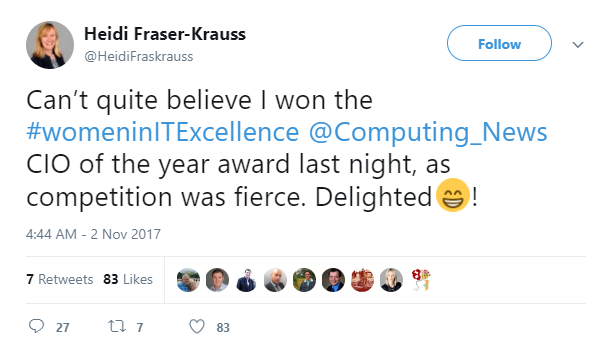
If you also follow IT Services on Twitter, you will have not just seen the glitz and glamour of the evening but may have also celebrated with us when Heidi was announced by Zoe Lyons, a University of York alumnus, as CIO of the Year!
We are incredibly proud of Heidi winning this award. Not only was this a celebration of women in the IT industry in general; Heidi’s win also brought the spotlight onto Higher Education. As the shortlist above shows, the competition was fierce.

From our perspective, on the event as a whole, it was great to see so many women from IT in one room together. However, some people may, and did, question the need for a women only award ceremony 'surely equality is all about level playing fields’. Although that is a debate that could very easily take up it’s own blog post, the answer to this was summed up very well by one of the speakers, and another University of York alumnus, Holly Brockwell.

“...In some areas there are zero women in the IT departments...but women have played and continue to play an enormous role and contribute massively to the sector...We are here to inspire the next generation of girls...Technology may create the future, but women are creating the technology.”

[my edit here: if you haven’t seen the film Hidden Figures I urge you to do so].

Before the awards were announced we were given an inspirational talk from Bonita Norris who in 2010, and at the age of 22, was the youngest British woman to reach the summit of Mount Everest. We all came away from hearing Bonita speak a little humbled at our own achievements and, for me anyway, with more confidence to believe in ourselves.

She commented on her feeling of fear and admitted that that feeling should never go away, but if you trust yourself you will conquer the fear.

For Bonita, reaching Everest was a case of simply taking one step at a time, focusing solely on the next step and not giving up when the going gets tough. She ended with this: “success is stringing along lots of small steps and taking leaps of faith along the way. All you need to do is conquer the next step”.

Having seen and heard so many amazing stories it made each of us reflect on our own journeys into IT. After a discussion with each other it became clear that there is no ‘normal’ route into the field. We wanted to find a way to share our experiences so we decided that further blog posts would reflect these and perhaps inspire others to take their own unique journey. In Heidi’s words, we should all ‘be brave, lead and realise that we can just do it’.


Take a look at our tweets from the night!

Tuesday, 31 October 2017

Women in IT excellence awards

Women in IT excellence awards

I’ve worked for Information Services for nearly ten years and one thing we’ve always said we need to improve on is celebrating our own success. So this blog is the start of a series of blogs from us celebrating our “Women in IT” and we’ve got a pretty good reason to do so.

This week we’ll be travelling to London in support of Heidi Fraser-Krauss, Director of Information Services, who has been shortlisted for not one but two Women in IT excellence awards; CIO of the Year and Role Model of the Year (SME). The awards aim to celebrate the “groundbreaking work being done by women in the industry every day”.


Although the awards are a celebration they also highlight the low number of women working in technology. The current statistics show that the proportion of women working in STEM jobs in the UK is only 17%. The awards want “to inspire the next generation” and “to show them the remarkable footsteps they're following in”.

Following on this theme we’d like to showcase, through a series of blogs, some of our female staff and share their stories of working in IT so that we might inspire others. Starting with Heidi:


Heidi Fraser-Krauss, Director of Information Services

itIAet-y.jpg
“To be a good role model to other women in business it is important to be visible at both a junior and senior level within the workplace as well as in the wider IT industry. I have done this through adopting the Sheryl Sandberg principle of “leaning in’. For example, I took on the role of chairing the Russell Group IT Directors Group, which is male dominated, have given numerous presentations at events both inside and outside my organisation and am currently organising my industry’s major leadership conference for 2018, UCISA18.

Visibility has provided me with the platform to inspire other women to apply for jobs in IT and take a proactive role in encouraging more women to think differently about the IT industry. I have mentored women from other Universities about how to progress their careers, being open and honest about the challenges I have faced. I have found it helpful, when mentoring, to share my family circumstances (I have three children) and have been honest about how I have juggled home and work life. As often, it’s practical issues that hold careers back. I have stressed that IT is a great career if you have a family because it's flexible and can be done from home.

My top tip for women looking to start a career in IT is to not be afraid of the technology. The common assumption is that you must have the technical ability to solve problems with hardware or software to succeed – this is not the case. I came into IT via business analysis, and have found that my broad understanding of the business and my ability to manage people is what has enabled my career to progress.

The biggest lesson I have learnt in my career is to overcome my squeamishness at promoting my skills and abilities. Putting myself forward for this award was really outside my comfort zone. I really hate ‘blowing my own trumpet’ and find it deeply embarrassing to do so, but, I have learnt that if I don’t, I will be passed over in favour of those who have no hesitation about extolling their own virtues!”

To make Heidi squirm a bit more, here’s why we supported her nomination for the awards:

  • “From the minute you meet Heidi you can tell that she is passionate and committed to her role at the University”
  • “Despite running a large department she makes time to listen to all staff making sure that everyone has an equal voice. Through this she has fostered an environment of collaboration and cooperation. This has really put IT at the forefront of everything that is done at the University.”
  • “Having a CIO that is both approachable and makes you feel valued is extremely important and Heidi excels at both these things.”
  • “As a woman working in a technical role within IT, it is very encouraging for me to see a female role model in a senior position.”

The awards take place on Wednesday 1 November and we’ll be live tweeting from the event so follow us on Twitter for updates @UOYitservices