Showing posts with label DVD collection. Show all posts

Friday, 23 November 2018

J.B. Morrell in an Exciting Adventure with Time (and Robots & Ducks) in Space!

To celebrate the 55th anniversary of Doctor Who, we asked Teaching & Learning Advisor and self-confessed 'Doctor Who bore' Stephanie Jesper to write something that would highlight the Who-related content within our collections. Here's what she came up with:
Five hours, 16 minutes and 20 seconds (or thereabouts) into the afternoon of Saturday 23rd November 1963, sightings were reported across the country of…
“...an upward shooting probe, similar in a schematic way to conventional representations of space craft taking off. But this upward probe immediately broke up and tilted over to merge with forward rushing ‘clouds’...” (Tulloch & Alvarado, 1983; p.21).
What was this mysterious probe, observed on that November evening 55 years ago? And what, if anything, did it have to do with the disappearance, that same night, of a teenage girl and two teachers from their East London school? Ian Chesterton and Barbara Wright's testimony following their sudden London 1965 reappearance (without pupil Susan Foreman) only served to further fuel speculation that the observed probe and the disappearances were the result of an alien abduction. But surely such claims are nonsense?
According to Barbara and Ian's testimony, they had been concerned about the welfare of schoolgirl Susan Foreman, and had followed her home only to discover that home was an old police-box in the I.M. Foreman scrapyard at 76 Totter's Lane, Shoreditch. This police-box, they claimed, was actually a spaceship (they called it the TARDIS) capable of travel through time, and both Susan and her grandfather, who they referred to as the Doctor (Doctor who??), were aliens: wanderers in the fourth dimension. Terrified of being discovered, this Doctor character abducted the teachers. But he was unable to steer his spacecraft reliably, and Ian and Barbara were only able to return to London 1965 by stealing another time-ship -- which they then destroyed.
Inevitably, this testimony has met with a good deal of suspicion. But those mysterious sights on that Saturday evening have leant credence to their story, and there is a growing contingent who claim that this was indeed a genuine alien abduction. They point to a number of other cases of suspected alien activity throughout the 1970s or 1980s, most of which they believe to have been fended off by an organisation called UNIT (United Nations Intelligence Taskforce). UNIT have been keen to dismiss these alien activity theories, claiming their role is purely humanitarian. In an attempt to assuage further speculation regarding the 1963 incident, they have released the following footage, pieced together from recordings made at the time:
It is UNIT's position that the events of 23rd November 1963 were not an alien abduction at all, but instead nothing more than a BBC Drama production: a television series preposterously entitled 'Doctor Who'. Yet nobody I've spoken to has heard of this show. What evidence can we find to support their ridiculous claim?
I started with a YorSearch search for this 'Doctor Who' moniker. There are 10 books on the shelves that claim to be about this supposed television programme. Most of them are in the section 'LP' on the second floor of the main Library. Here they are, between Desperate Housewives and EastEnders:
Shelved books, from LP 4.572 DAL/A to LP 4.572 GUI/I
There's also a load of articles available online... almost 500 of them. Are these texts an elaborate UNIT hoax designed to put us off the scent? In search of answers, I did some reading.
It's the claim of these books and articles that on 23rd November 1963 BBC Television aired the first episode of this 'Doctor Who' thing. But the details they give regarding this broadcast are fanciful to the limits of credibility: the programme was produced by a 28-year-old woman, which would make her the youngest producer at the BBC, and the only female producer, at that time; as this Music thesis in White Rose eTheses Online explains, the haunting theme music was realised by a 26-year-old woman and her pet oscillators: Wobbulator and Jason; its director was both British-Indian and gay... These are levels of representation uncommon now, let alone in the early 1960s! The whole thing seems too fantastical to believe.
If this series was actually broadcast, there must be some record of it in BBC Genome. I looked. There is. There was also stuff turning up in the newspaper archives we have access to. The evidence was mounting. And yet I kept asking around and nobody I talked to had any recollection of ever seeing such a programme. Something didn't seem right. I needed to witness this supposed show with my own eyes. I turned to Box of Broadcasts, and this is what I found: not just one episode of 'Doctor Who', but almost 200!
Working my way through the playlist I'd created, it started to seem like UNIT were right: this was nothing but a television series, albeit an amazing one! Barbara and Ian weren't missing teachers in real life, but well-written characters undergoing genuine development as they traveled to the future, the past, and sideways through time with their irascible alien captor and his granddaughter. Even this Doctor himself changed across the course of the series, on occasion dramatically so. He had been recast multiple times, sometimes replaced with a younger actor, and (I discovered as I skipped to the end of the playlist) now he was even being played by a woman! Yes, this could only be a television programme.
As well as all these episodes on Box of Broadcasts, three series on DVD, and a few clips and episodes on BFI Screen Online, there were scripts at MA 192.9 DAV including one volume which included email and text conversations about the production of the series. With all this evidence mounting up, how could anyone doubt the claim that Doctor Who was a television series that had been going for 55 years (albeit with a big gap between 1989 and 2005 punctured only by a TV movie and a couple of charity comedy skits)?
It wasn't until I was reading Doctor Who: The Unfolding Text that the scales fell from my eyes. Here's the section in question:
“What Elam calls the semiotic ‘thickness’ (multiple codes) of a performed text varies according to the ‘redundancy’ (high predictability) of ‘auxiliary’ performance codes.” (Tulloch & Alvarado, 1983; p.249).
Now some might see this to be a statement about how the codes and conventions of other genres are used in Doctor Who to add new layers of meaning: how the Doctor and his/her companions travel not only to periods in time but to different genres... different television programmes. A historical adventure is an adventure in a costume drama, not merely in the past; the TARDIS travels not from time to time but from channel to channel; it's not an adventure in time and space but an adventure in your television.
And yet I recognised this sentence. I recognised it from an episode of the Doctor Who serial "Dragonfire":
“Tell me -- what are your views on the assertion that the semiotic thickness of a performed text varies according to the redundancy of auxiliary performance codes?” (Briggs, I., 1987; p.65).
Yes... This 'series' was even having adventures within its own critical media. It brought to mind the 1968 serial "The Mind Robber", in which the TARDIS crew find themselves in a world of literature devised by the creator of a boys' own adventure character called Captain Jack Harkaway... A name surprisingly close to another Doctor Who character: Captain Jack Harkness. It seemed to me that the boundaries between reality and fiction were melting. I no-longer felt I knew what was real anymore and what was make-believe.
As I lay on one of the Fairhurst settees, confused and befuddled, with a freshly made mug of tea by my side, I was approached by a mysterious character with a Scottish accent who addressed herself to me as 'Miss Why' (unquestionably a pseudonym). She offered me the choice of two jelly-babies — one red and one blue — and whispered: "All I'm offering is the truth. Nothing more. You take the blue jelly-baby – the story ends; you wake up in your bed and believe that this 'Doctor Who' thing is just a telly show. You take the red jelly-baby – you come to Wonderland, and I show you how deep the rabbit hole goes."
Two jelly babies: a red one an a blue one. The blue one is covering its eyes...
Now I know one should never take sweeties from strangers, but on this occasion the temptation of a juicy red jelly-baby was simply too much. I thanked the mysterious woman and bit the head off the red jelly-baby with relish. 'Miss Why' then stuck the blue one in her own gob and grinned wildly, before taking my hand and leading me to a door I'd never noticed before.
What I saw beyond that door you would scarcely believe. The room that lay behind it was huuuuge! I had no idea the Fairhurst was so extensive. I couldn't make sense of whereabouts in the building we must've been. But then we weren't in the building. We were in a dimensionally transcendent space-time vehicle!
My jaw dropped with the realisation. At the centre of the room, what looked like a perspex column with a colander inside rose up and down, accompanied by a wheezing groaning sound. We were in flight.
"Where are we going?", I asked.
'Miss Why', clearly another incarnation of the Doctor under a far from opaque pseudonym, explained it all: she was a renegade Time Lord who'd escaped her home planet of Gallifrey (in the constellation of Kasterborous) with a device they called The Matrix: a massive computer system that acts as the repository of the combined knowledge of her people — kind of like White Rose Research Online. But this Matrix was capable of recording all the events taking place within and around any TARDIS ship, which meant that every adventure of every Time Lord (the Doctor included) was retained therein. The DVDs on our shelves in the John Barry Audiovisual collection; the episodes on Box of Broadcasts — these weren't television; these were Matrix recordings which UNIT had somehow managed to get hold of and edit into regular 25 minute episodes as a ridiculously convoluted way of covering up alien activity: alien artifacts actually being used to distract us from the aliens... it was the perfect deception!
"So why has no-one ever heard of this 'Doctor Who' programme?", I asked.
"Because I've altered time, silly!", the strange Scottish woman replied, hooking the bamboo handle of a large umbrella around one of the ship's controls and letting it carry her weight that she might arc, gracefully, towards me.
I gulped. There was something about the way she was acting now that seemed a little more sinister than I'd expected of the Doctor. I began to wish I'd not skipped to the end of that BoB playlist, but watched everything on it lest it would've given me some sort of clue.
"I've taken that pesky Doctor out of things entirely," she smirked, head lolling to one side. "The time streams just take a little while to correct themselves. Especially in York. Nothing ever changes very quickly in York."
"That's why there was still physical evidence here in the Library?"
"Who's a little clever-clogs?", she chuckled, prodding me in the forehead.
I tried to make sense of what I was hearing. There had been a series called 'Doctor Who' but it was actually snippets of real-life events recorded to an alien repository. These had been intercepted by UNIT and broadcast as fiction in order to discredit claims of alien activity on Earth (including the exploits of the Doctor). And now this intervention (or certain parts of it) had been unpicked by the woman standing in front of me... just a few inches in front of me. And now I knew everything that had gone on. Well, not everything, but a fair bit... A dangerous proportion! If huge swathes of television broadcasting could be unwritten, then surely so could I!
And yet it had not entirely been unwritten. It was still here. In York. Protected by those ancient walls. And now I also began to feel it in my head: I could feel memories I'd forgot I'd had, lurking at the back of my mind... sleeping. I knew I had to wake them up: to bring them back in front of my eyes. I had... to remember... 'Doctor Who'... Not just the episodes I'd seen on Box of Broadcasts. Not just the stuff I'd read in the books. No. I had seen it all. I had seen Doctor Who! I remembered! Human-sized moth creatures, Yetis on the underground, great big maggots, standing stones that could drink blood, massive pink snakes, walking plants, cat people, some bloke who always liked to dress for the occasion (not sure what that was about), flatulent bodysnatchers, tig-playing statues, lizard people, a kid under a blanket... My mind raced with these recollections!
I looked at the woman stood in front of me: Missy. It was Missy — The Master — the Doctor's greatest enemy-slash-friend. I spoke as boldly as I could: "You can take the girl out of York, but you can't take York out of the girl!" I must confess, I didn't know where I was going with this, but I felt strangely confident that whatever ancient forces had protected York from the timeline interference were now also protecting me.
Missy scowled at me, and was just about to say something really scathing when she faded out of existence. York was refusing to be rewritten, and my presence in that time machine was causing some sort of interference. I felt peculiar and stretched my arm out to the control console to steady myself. As I made contact with the panel, a huge jolt of energy surged through me, and the console sparked with a brilliant green flash.
What happened after that, I don't know. My body had decided that this would be a convenient point in the plot for it to fall unconscious...
I was awoken by the strangest sensation at my ear: a sort of gentle hissing and light nibbling. I opened my eyes, tentatively, but all I could see was the blue of the sky. Blinking, I peered at whatever was prodding at my ear. It was a tiny duck.
"SUB-JECT IS A-LIVE!" came a tin voice from my left. I snapped my head around to see a small robot rocking from side to side. I sat up, somewhat bewildered, and took in my surroundings. Me, the robot, and the duck were all on the Fairhurst lawn. In the distance, one of the local rabbits was chewing at a dock leaf.
The author, unconscious on the Fairhurst lawn, a tiny duck at her ear, and a small robot watching over her
The duck leapt onto my lap, shook out her wings, and clapped her bill a few times in various directions in quick succession. "Hi," I said, for want of any better response. "Good afternoon!" the duck replied, in a quacky sort of way.
Then a curious gent with a pleasant open face appeared in my peripheral vision. There was something familiar about that face. "Doctor...?" I asked, quietly.
He chuckled. "J.B. Morrell, at your service. As ever I am..."
He proffered a hand towards me. I took it to shake it, but instead he helped me up off the ground. The duck flapped down to the ground and stood with the robot at the man's feet.
"I took the liberty of restoring the time streams as they had been before any 'unfortunate' interventions took place. I hope that wasn't an impertinence on my part?"
"Far from it!" I assured him. I looked about to check that everything was where I thought it should be. It was. "But how...?"
J.B. Morrell pointed towards the building that bears his name. "Good Library, that. There's more knowledge in there than you'd think. It's bigger on the inside than it is on the out."
"You mean with all the online resources as well as the physical stock?" I asked, naïvely.
He chuckled again. "If you like; if you like!" And then he walked away, the duck flapping merrily behind him. The robot turned its head. "Come along, Java!" called J.B. Morrell, and the robot rolled away after him, across the grass.
Absently, I looked over at the Library buildings, and suddenly remembered that somewhere in there my tea was getting cold. I turned back to thank J.B. Morrell and his friends, but, inevitably, they were nowhere to be seen. I dusted myself off, took a deep breath of fresh air, and headed back inside the Library, resolving to check that all the Doctor Who stuff I'd seen in there before was still there now. It's something I urge you to check too. Just in case. You never know when someone might try to tamper with history again...
J.B. Morrell and his companions, ready to head off on another exciting adventure...

Monday, 11 June 2018

A walk in the Park? Jurassic Park at 25 and the enduring popularity of dinosaurs.

The 11th June 2018 marks the 25th anniversary of the release of the movie Jurassic Park. Based on the 1990 novel by Michael Crichton, Jurassic Park is a blockbuster which has stood the test of time and spawned an ongoing franchise of movies and games. The film won three Academy Awards, two BAFTA awards and key scenes remain staples in lists of favourite film moments. Released in 1993, Jurassic Park set a new standard of animatronics, bringing dinosaurs to the life as never before and sparking renewed popular interest in the prehistoric.
But although Jurassic Park (and the subsequent sequels) may have been the most successful appearance of dinosaurs in cinema, this certainly wasn’t the first time dinosaurs had captured the popular imagination, nor even their first appearance on the big screen. The growth of the discipline of geology in the early nineteenth century saw new developments in general understanding about the age of the earth and the existence of now extinct species, in turn developing the discipline of palaeontology. The identification of different geological layers helped date discoveries of pioneers like Mary Anning, who discovered numerous important Jurassic specimens along the Lyme Regis coastline, from 1811 onwards. Geological societies helped establish collections which would in turn form the basis of museum departments.

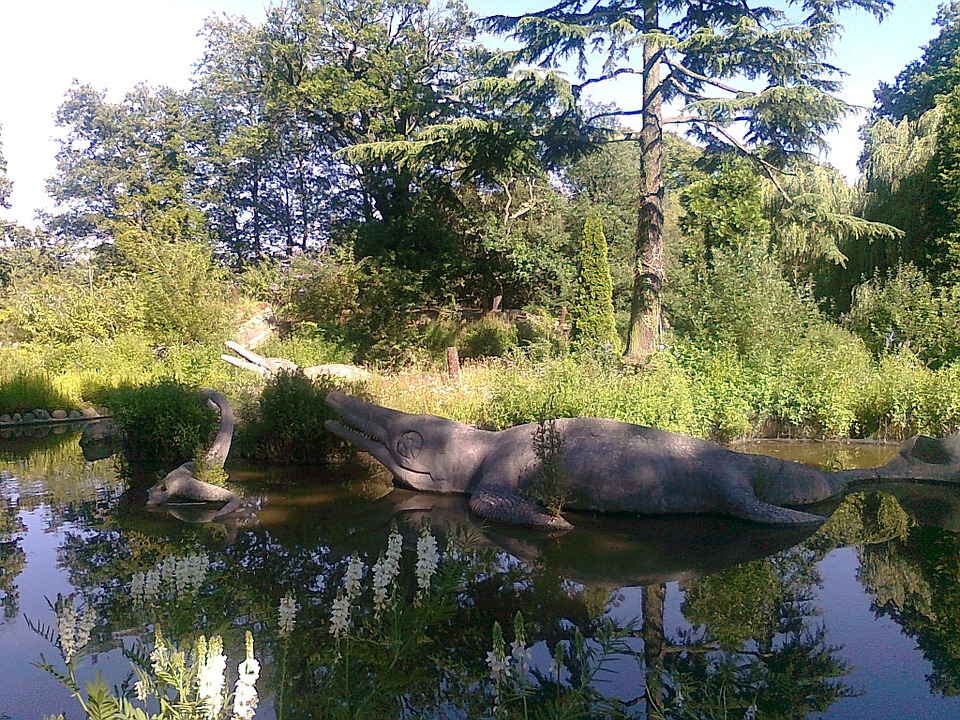
Still on display, the Crystal Palace dinosaurs
are now a Grade 1 listed landmark. (Image from Pixabay)
Popular interest was fuelled by increasing public access to museums and projects like the Crystal palace dinosaurs, unveiled to the public in 1854 and the first life size replicas of extinct animals. Artist Benjamin Waterhouse Hawkins produced vast sculptures representing these prehistoric creatures. Although inaccurate by modern understanding, this was a serious attempt to represent the creatures properly, with advice taken from the eminent palaeontologist Sir Richard Owen. More fanciful were representations in the emerging literary genre of science fiction, perhaps the most famous example being Sir Arthur Conan Doyle’s novel The Lost World, first published as a serial in 1912.
The Lost World establishes an archetype of fictional dinosaurs - plots centred on remote places where dinosaurs and other extinct creatures have miraculously survived. Conan Doyle creates an isolated jungle plateau, but hidden valleys and forgotten islands are often used for the same effect. The alternative thread of dinosaur fiction emerging through the twentieth century, of which Jurassic Park is part, saw not the discovery of hidden dinosaurs, but rather their scientific resurrection or recreation. As greater understanding of dinosaurs and of the possibilities of genetic engineering grew, so did ideas about the capability of somehow recreating extinct creatures. Dinosaurs could play a part in stories about the limits and consequences of unchecked scientific experimentation.

This is not to say that all late twentieth century approaches to the topic were so thoughtful. Whilst Jurassic Park offered bioethical questions in the midst of an action blockbuster, other 1990s film efforts were not so successful. Released only a year after Jurassic Park in 1994, Dinosaur Island is on a distinctly lower budget, feels far older and was widely panned. The film uses a variant on The Lost World model - US airmen crash on a remote island, inhabited solely by scantily clad women and the prehistoric creatures who menace them. The plot, film quality and attempts at special effects have all aged badly, with the film arguably little more an excuse for extensive on screen female nudity.


But neither are plots based on scientific resurrection of dinosaurs guaranteed success. Even allowing that any scenario involving the recreation of dinosaurs would be far-fetched, the 1993 film Carnosaur tries to raise issues about scientific development and future dystopia which are largely lost in a mind-boggling improbable storyline in which a lethal airborne virus impregnates women with genetically mutated dinosaurs. It was not critically well received and nor were the following two sequels; the second of which has the genetically altered dinosaurs as an experimental weapon, the third was straight to video.


Much of the success of Jurassic Park is due to the apparent realism of the dinosaurs. Although many earlier portrayals of dinosaurs on film took little interest in the accurate portrayal of their extinct subjects, the twentieth century saw increasing efforts to portray prehistoric creatures with greater scientific precision, even in fiction. One of the earlier examples of this more factually based dinosaur entertainment can be found in Disney’s 1940 feature length film, Fantasia. The animated section accompanying The Rite of Spring shows prehistoric life, culminating in epic sequences depicting the dinosaurs and their demise. Although an animation created for popular entertainment, efforts were made to maintain some level of scientific accuracy, with the studio taking expert advice from authorities including the director of the American Museum of Natural History, the biologist Julian Huxley and the palaeontologist Barnum Brown.


Fantasia gives probably the least anthropomorphised depiction of dinosaurs from the animated depictions. Jurassic Park was not Spielberg’s first foray into dinosaurs on film - he was the producer of the animated 1988 film The Land Before Time. Reminiscent in animation style of the Fantasia sequence, this is another story set in the age of dinosaurs, without any human interference. Although the basic dinosaur behaviour is broadly accurate, the dinosaurs are named and anthropomorphised - given voices an inter-species gang of young dinosaurs face peril and adventure as the plot unfolds. The project had originally intended the dinosaurs to be portrayed more “naturally”, without dialogue, but the decision was taken to create the protagonists as characters with voices. (Whilst a very different approach to dinosaurs on film, like Jurassic Park, The Land Before Time proved popular and also gave rise to numerous sequels).

Not technically a dinosaur, but a Jurassic creature,
CGI enabled portrayal of pterosaurs on film. (Image from Pixabay)

The incredible developments in Computer Generated Images or CGI in more recent years have seen changes in the way dinosaurs are brought to the screen. Without the total reliance on models and animatronics, new creative possibilities are opened up, such as the depiction of flying creatures such as pterosaurs. The blending of animatronics and CGI - as was done in Jurassic Park and various subsequent representations- allows close interaction between human and dinosaur actors, as well as giving the potential for use of different environments and the creation of whole herds of dinosaurs - the sheer numbers of which would have been both vastly expensive and impractical were a production to rely solely on models. The innovative blend of live action, models and CGI helped win the film multiple awards for special effects.


Unusually, fact followed fiction in taking this blended approach. The 1999 BBC documentary series Walking with Dinosaurs created a series of nature documentaries, following prehistoric individuals in the same format as a wildlife documentary about a living creature. This series also used a combination of animatronics and CGI, with real locations providing the natural backdrops to the action. Although a factual series, it was inspired by the public interest created by Jurassic Park and used many of the same techniques in portraying dinosaurs on screen.

A Turkey sized terror (Image from pixabay)
So how realistic are the dinosaurs in Jurassic Park? In any scientific field, new knowledge comes to light and changes past understanding, so portrayals will change. Palaeontologists could take umbrage with the film’s title. Although the brachiosaurus is a Jurassic era dinosaur, many of those featured in the film are not. The triceratops is from the cretaceous era, as is tyrannosaurus rex. Velociraptors are also cretaceous and although widely accepted that they did hunt in packs, in reality these carnivorous dinosaurs were considerably smaller than in the films. Instead of standing over 7 feet tall, as in the movie, these predators were actually around the size of a large domestic turkey. Additionally, it is also thought they may have been feathered. Although the similarities between birds and dinosaurs is mentioned in the film, most notably with the ostrich like gallimimus, feathers are not introduced. It is easy to see why filmmakers were tempted to introduce the iconic triceratops and tyrannosaurus rex to the dinosaurs featured in the park, but the Jurassic era also had well known species. Pterosaurs were common, allosaurus and megalosaurus were major predators, stegosaurus perhaps the most recognisable dinosaur of the period (these species do start to make appearances in later films from the franchise).

A detail of Dippy, a long time favourite at the
Natural History Museum of London, now on tour
around the UK. (Image by dronepicr, via wikimedia commons)
Twenty five years on, Jurassic Park has aged well and still stands up as an action film. The ongoing series of sequels suggests a continuing appetite for prehistoric creatures on film, whilst dinosaurs remain a perennial favourite in any natural history museum. The crowd pleasing quality of dinosaurs is attested by Natural History Museum of London’s decision to host a mini-site The Dino Directory and the popularity of events and exhibitions, such as Dippy the Dinosaur, the star of a national touring exhibition, and Yorkshire’s Jurassic World, recently opened at the Yorkshire Museum. So what is the enduring appeal? Perhaps the dramatic function is that dinosaur fiction is both scary and safe. These are powerful creatures about which we know little allow for a thrill of fear-these creatures could have crushed or eaten you - but the reality of their extinction renders the same - they pose no threat to the modern audience.

The dinosaur perhaps also reminds us of the changeability of our planet and human transience upon it. With increasing awareness of climate change and loss of biodiversity, focus on extinct species can add poignancy. Narratives using the “Lost World” device of the hidden prehistoric habitat can give rise to stories questioning human impact on the natural world and habitat destruction, whilst those plots resurrecting the extinct through science allow for the exploration of ethical questions about genetic science and the human exploitation of other species. In the original Jurassic Park film, the emphasis on chaos theory and the violent failure of the park offers a message that commercialised science is exploitative and potentially dangerous. And there lies the irony. As Megan Stern notes in her article Jurassic Park and the moveable feast of science, Michael Crichton and Steven Spielberg succeed where the film’s John Hammond fails. Although the narrative depicts disaster for the resurrection of dinosaurs for commercial exploitation, it is a feat which Jurassic Park accomplished with great success.

Find Megan Stern’s article Jurassic Park and the moveable feast of science, in the journal Science as Culture, Volume 13, issue 3, 2004. University member? Log into Yorsearch and get access to Science as Culture online.

Inspired to re-watch the movie? Find the DVD of Jurassic Park at shelf-mark LP 4.30973 SPI in our audio-visual collection.


Read Conan Doyle's classic adventure The Lost World, available in the J B Morrell Library at shelf-mark MA 173.9 DOY.

Yorkshire’s Jurassic World is curated by York Museums Trust and is open at the Yorkshire Museum.


Thursday, 8 January 2015

Weren’t we promised flying cars by now?

It may come as a shock to readers of a more mature vintage to learn that the classic futuristic film Blade Runner was set in 2019. Tom Grady wonders how close we are today to travelling by flying car.


'San Diego Comic-Con 2007' by Jason Scragz. Re-used under a Creative Commons licence.
The film was made in 1982 but only 3 years earlier, the Usborne Book of the Future was predicting all kinds of interesting developments (not seen any gold mines in the sky yet, but artificial intelligence and 'space-based superscopes' weren't so wide of the mark).

And Marty McFly may have been using his hoverboard in 2015 but it doesn't look like we’re going to see them in Currys any time soon (though you can buy them on Amazon where a prominent disclaimer warns the unwary buyer: "this product does not fly"). But we might not be so far away from seeing Ridley Scott's replicants working in your Library.

Westport Public Library in the US recently unveiled a pair of humanoid robots whose job will be "to teach the kind of coding and computer-programming skills required to animate such machines". Named Vincent and Nancy, the two robots have cameras, microphones and motion sensors, and use sonar to detect walls. An article in the Wall Street Journal explains:
Vincent and Nancy can recognize faces and detect where sound is coming from. They have a "fall manager" that helps them right themselves after a tumble just as a human might, grunts and all. They can even "touch" and "feel" with the help of tactile and pressure sensors.
The robots come equipped with programming software, but embedded within that software are compatible programming languages, such as Python, that can be used to expand the capabilities of the NAO bots. Aldebaran [the manufacturer] also has a large development community continuously adding new behavior apps that facilitate everything from high-five gestures to a "wake-up" routine including yawning and stretching.
This is what they look like (they're pretty cute):

Robot manufacturer Aldebaran's booth at an exhibition. Picture by Axel Voitier
re-used under a Creative Commons licence.
Aldebaran robots like Vincent and Nancy (picture credit as above)
And if that seems incredible, hold on to your hats because self-styled polymath will.i.am has just designed a futuristic car! Not a flying one, sadly (though one of those exists), but one that is "equipped with four 180-degree external cameras that allow panoramic photos to be captured on your phone".

Now, your initial reaction may be similar to that of Alex Petridis in The Guardian who observed that "there are people out there who'll say that taking 180-degree panoramic photos on your phone while you’re driving sounds incredibly dangerous - in fact, it sounds like the kind of thing you would find yourself doing immediately before accidentally running someone over". But who knows? will.i.am's invention could actually just be one step behind the realisation of Deckard's hovercar.

Further reading:

The Library has a couple of DVD versions of Blade Runner (Director's Cut and Final Cut) and we also have several books discussing its significance and genesis, as well as a copy of the draft script.