Tuesday, 23 October 2018

Open data and the scientific gift culture


Continuing our theme for International Open Access Week, Professor Kevin Cowtan, Department of Chemistry, writes about the value of open data for scientific research.

If you've applied for a research council grant recently, you'll know that research councils have become rather keen on 'open data' in recent years. Funders would like us, not just to produce new results, but also to provide all the data used in deriving those results. Many journals are introducing similar requirements.

At first glance this might appear as research funders imposing more bureaucracy on grant holders. However I would like to suggest that open data is fundamental to how science works, and in addition that releasing research data can provide significant benefits to the researcher themself.

All science involves building on the work of others, or 'standing on the shoulders of giants'. This makes science a gift culture - we take the gift of the work of others and in turn gift our own work to others for them to build on. Making our results available sooner increases the opportunities for others to build on them, or if necessary to point out our errors, both of which increase human knowledge. Releasing our data often increases the value of our work, because other researchers can test our hypotheses and others against the data. In open source software, these benefits are characterized by the slogans 'release early, release often', and 'given enough eyeballs, all bugs are shallow'.

Or that is what is supposed to happen. But does it work in practice? I would like to highlight three experiences from my own career which suggest that it does.

Example 1: In the 1990s Dr Paul Emsley and myself developed a new piece of software for X-ray crystallography, called 'Coot'. University culture at the time was heavily focussed on the commercialisation of software outputs, however we (not without difficulty) made our work 'open source', meaning anyone else could build on our work, and we in turn could incorporate the work of others. This turned out to be a very good decision: Coot quickly surpassed and largely replaced all competing tools, and for the past few years the software has typically been cited in around 10 new peer-reviewed papers every day. The use of the software in industry as well as in academia produces an economic impact.

Example 2: Around 2013 I became interested in climate science, and identified a problem with how a major historical temperature dataset was being used. Users assumed that the data were global in coverage, when in fact they were not. I published a paper on estimating an unbiased global mean from the incomplete data, but also released the data and monthly updates from then on. The dataset has attracted over 200 citations and been used in official reports from government organizations. The name recognition this has generated has made it easy for me to build collaborations with climate scientists - which is not always easy when starting in a new field.

Example 3: In 2015 I identified a problem in how climate model simulations are compared with observations - the most commonly used method did not provide an 'apples to apples' comparison because of complexities of the historical data. A correct comparison involved some dull but careful data analysis. Again, I released the software as well as the data. Several subsequent comparisons have made use of this code, leading to both citations and co-authorships, at least one of which will be REF returnable.
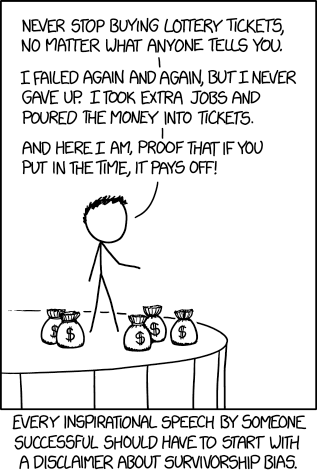
Image courtesy of XKCD, https://xkcd.com/1827 
under a CC BY-NC 2.5 licence
Now, this may all have been luck. After all, had I not had success in releasing data and computer code, I would not have been asked to write this blog post. There could be hundreds of people releasing data and not seeing any benefits. I could be the beneficiary of 'survivorship bias', explained by Randall Munroe in the comic XKCD.

However there are objective reasons to believe that releasing data does benefit the researcher. In 2013, Piwowar and Vision found that after controlling for a range of other factors, papers with open data received more citations than papers without open data. Open data also provides economic impact, estimated for example by Houghton and Gruen in 2014, which when measurable may be useful to the department and the researcher for REF "impact" studies.

In summary, open data is a natural extension of the principles of good scientific research: science is and has always been a social activity, and the gifting of information is fundamental to that activity. Studies of open data publications show benefits both to the researcher and to the wider economy. My own research career has been built on giving away data and computer code: not every case has led to benefits, but the net benefit over the course of my career has far outweighed the time cost of releasing the data.


Professor Cowtan is an interdisciplinary data scientist working in the fields of X-ray crystallography and climate science. While most of his career has been at the University of York, he has also spent sabbaticals at San Diego Supercomputer Centre. He is the chair of the university Research Data Management committee.

Monday, 22 October 2018

White Rose University Press: an Open Access publisher from the Universities of Leeds, Sheffield and York


To kick off our series of posts for International Open Access Week, Kate Petherbridge, White Rose Libraries Executive Manager, writes about the work of White Rose University Press and the benefits that open access publishing can bring for authors and the wider research community.


White Rose University Press (WRUP) is the library-led university press of the Universities of Leeds, Sheffield and York. It opened for proposals in 2016. Two years later, WRUP has made considerable progress from a standing start. Open Access (OA) Week 2018 seems a good opportunity to reflect on this progress and why new academic-led and university presses like WRUP are becoming more important in the HE environment.

Why an Open Access Press?

The White Rose Libraries (WRL) work together on different projects. WRUP is a product of this collaboration. One driver behind its creation was feedback from academics across Leeds, Sheffield and York universities who flagged that there were limited options for academics who wanted to publish their research OA. This coincided with institutional concern about the costs of buying content from traditional commercial publishers, and the growing focus on OA by funders and the government. WRL developed a not-for-profit university press to offer an OA publishing solution.

As a library-led press, WRUP operates in an area used to providing support to academics, and also with a focus on collaborative working. OA makes publishing evolve into an academic service, and WRUP enjoys working closely with its academic authors and editors. They have input into production choices, licensing, design, distribution and marketing for their publication. Feedback shows that academics appreciate the opportunity to work closely with the publisher in this way.

How does it work?

As with other academic publishers, books and new journals go through a formal proposal and full peer review process. Commissioning decisions are made by the WRUP Editorial Board, consisting of academics from across the three universities. Commissioned publications are produced to a high standard, with all the expected design elements and processes such as copyediting, typesetting, indexing etc. available.

What is different about OA?

OA publishing is different in some key ways, notably in the areas of dissemination, rights and funding.

Dissemination

OA books and journals are free for everyone to access online. You don’t need to be associated with an institution that can afford a subscription or to buy a copy of a book to access the research. The primary OA product is digital. WRUP offers its books and journals free to read online or downloaded in a variety of formats. This free global access means that academics, practitioners, policy-makers and the public all have the same access to high-quality academic research. WRUP also offers books for purchase via print-on-demand as OA publishers understand that people still want the option of a printed volume.

Rights

In traditional publishing, authors commonly sign their copyright over to the publisher. This can make it difficult for them to reuse sections of their own work. It is also a barrier to other academics freely sharing and building on that research. OA content is published under Creative Commons Licences. Authors retain the copyright to their work, and can use the licence to set the conditions around which others can copy, distribute, and make use of their work. This opens the research up in a way that traditional “all rights reserved” publishing does not. OA maximises the value of that work in terms of how it can be shared, but also how it can be built on and combined with other research in an evolving discussion.

Funding

This is a key source of contention around OA publishing. It’s a divisive issue and one that OA sceptics use to predict the long-term failure of the model. Many describe Gold OA (the WRUP model) as “author pays”. There are costs associated with the publication process and these have to be covered. In the case of WRUP these costs have been met through grant funding, funding from societies, or funding from the author’s own institution – the authors themselves have not had to pay.. A scalable solution is needed, however. Latest discussions include proposals from Science Europe’s cOAlition S. Their Plan S details 10 principles, some of which address fees (who should pay these, potential capping). It will be interesting to see how that conversation develops.

What are the benefits of OA?

There are many benefits to authors who publish in OA journals. OA articles tend to be viewed more than those that need a subscription, which often results in higher citation rates. OA articles can also reach a wider audience as they are not dependent on those who can afford the subscription cost. OA increases your visibility within your field and helps you build upon your academic reputation. It brings research to new audiences, inside and outside academia, and because of this there is likely to be greater public engagement. OA publishing makes your research easy to access if found through Google and other general and academic search services.

How is WRUP doing?

WRUP currently has four journals, each with its own editorial structure and peer review process. Two were “born” with WRUP, and two flipped from other publishing models. These journals have a mix of publishing patterns (from rolling publication of content to regularly publishing a defined volume) and cover a range of subject areas.

WRUP has also published three monographs since April:

•         Star Carr Volumes 1 and 2, Prof Nicky Milner, Dr Chantal Conneller, Dr Barry Taylor (eds.)
•         320 rue St Jacques: The Diary of Madeleine Blaess, translated and edited by Dr Wendy Michallat
•         Oysters, nightingales and cooking pots: Selected poetry and prose in translation. By Tristan Corbière, translated by Christopher Pilling, edited by Dr Richard Hibbitt and Dr Katherine Lunn-Rockliffe

Star Carr, WRUP’s first monograph, was downloaded nearly 1000 times in its first three days of release in April. Five months on and it has been downloaded over 4100 times by a global audience. 140 print volumes have also been sold via print on demand. The Madeleine Blaess diary, released a couple of weeks ago in September, has been downloaded over 230 times already. For context, the average commercial print run for monographs is now reported to be 150 copies, many of which sit on the shelves of HE libraries. The OA figures represent active engagement with the research.

What next?

The OA debate increasingly focuses on monographs. The expected expansion of OA requirements to monographs in the third Research Excellence Framework (REF) was flagged in 2016. Research England continues to move this forward and explore how the policy could work. It is an advantage for academics of Leeds, Sheffield and York to have a “friendly” OA University Press to offer support and information. WRUP colleagues are happy to answer any questions about OA in general, or to discuss potential proposals for journals or monographs. To get in touch email universitypress@whiterose.ac.uk or ring 01904 323803.

WRUP has more publications in the pipeline, including monographs on Capability Brown, the ongoing cultural legacy of Charles Dickens, and the prehistoric development of human social emotions. It’s exciting to see so much fantastic work made freely available to all, and add to the growing pool of OA scholarship.


As White Rose Libraries Executive Manager, Kate Petherbridge works across the university libraries of Leeds, Sheffield and York, leading and facilitating their areas of collaboration. These are varied, and include shared repository services, shared collection management work and, most recently, White Rose University Press.


Wednesday, 3 October 2018

On becoming a digital citizen...

Over the summer we've run a series of blog posts on the topic of digital citizenship, drawing upon material from the MOOC on Becoming a Digital Citizen which we ran last year. In this final post of the series, Susan Halfpenny wraps things up...

The distant, out-of-focus lights of a city

So what does it mean to become a digital citizen? In the first blog post in this series I stated that “the ‘digital citizen’ is a person who has developed the skills and knowledge to effectively use the internet and digital technologies”; someone who makes use of these technologies in a appropriate and responsible way to engage and participate in society and politics. Isin and Ruppert (2015) take this definition a step further, suggesting that if we constitute ourselves as digital citizens, we have become subjects of power in cyberspace: we are enacting ourselves on the internet, considering and understand the opportunities presented by this medium, such as anonymity, open communication, and participation across geographical boundaries. The digital citizen is also aware of the challenges presented by our information society and a post-truth era where governments have the technology for surveillance on a mass scale.

In this blog series we have considered some of the opportunities and challenges that digital communications technologies present. Is the internet of things presenting further opportunities for mass surveillance? Is anonymity really an option online, or are we risking being publicly shamed? We've looked at both the positives and negatives that technologies can present: how these technologies can be harnessed to improve communications and benefit societies, and how they can be employed to manipulate information and prevent participation. Through the exploration of these topics we can start to comprehend the complexity of our digital citizenship.

When writing our course on digital citizenship, the key concept we felt that resonated throughout all of the topics were ideas of evolution, change and development, and society. There is an interesting contradiction posed by the permanence of online transactions and the vulnerability of our online data. Revisiting this topic in blog form, these themes have once again become apparent. Once you start to explore some of the complexities of the internet and digital communications — and the ways in which they have influenced our behaviour as citizens — it raises more questions that require further consideration before we can state with certainty that we have become a digital citizen (or even truly understand what it would mean to be one).

The digital citizen is therefore a multifaceted beast, and what it means to become a digital citizen is open to interpretation: it changes dependent upon you perspective, reflecting your beliefs, values and ideals. In a sense you don’t ever become a digital citizen: it is a continual process of learning, engaging, and participating in our digital society.

We hope that this series has sparked your interest in how digital technologies have changed behaviour, society, and culture. If you are interested in finding out more about the digital society, why not join Stephanie and I as we embark on our new learning journey... into the world of digital wellbeing! In our new free online course, Digital Wellbeing, we will be exploring concepts of health, relationships and society in the digital age. If that sounds interesting, do feel free to sign up! We look forward to seeing you there...

Digital Wellbeing:
a free online course
15th October 2018

A girl reading a magical book. University of York -- Digital Wellbeing : a free online course -- 15th October 2018

Wednesday, 19 September 2018

The digital world as a uniting force

This week we begin to draw our digital citizenship strand to a close with Alison Kaye looking at some of the various ways in which our digital world can bring us together...

A tangled net

The internet, and social media in particular, has broken down tremendous boundaries.

Once, if we wanted to talk to someone at the other side of the world, we would probably do it through a pen-pal scheme. Conversation would be a slow process. We could perhaps make an international telephone call, but that would be terribly expensive. Now we can (and do) engage in live chat, send photographs and other media to each other, even talk by Skype: global friendships and global relationships have become a real, present, instantaneous thing. Many of us are now genuinely engaging in a global community (or at the very least an anglophone global community - the Tower of Babel has not quite been rebuilt, although translation systems become more advanced by the year).

Communities of interest have been able to come together in ways they never could before. It's really easy to find other people who are into that thing you're into. And that has benefits not just in terms of communication, but also in terms of organisation.

Crowdsourcing

Common crowdsourcing activities include crowdvoting and crowdfunding, but essentially it can be used for all kinds of purposes: to gain collaboration on creative or research projects; to gather ideas; to collaborate on a product; to gather data; to raise funding… It can be used for profit-based activities (and big businesses are certainly using these methods) but there is also a big potential for not-for-profit activities. Perhaps one of the most well-known crowdsourced activities online is Wikipedia, which we've been linking to liberally in these posts. This free online encyclopedia allows anyone to go in and add and edit entries for items, and at the time of writing it has over five million English language articles.

While such collaborative activities happened before the digital age, the internet provides an excellent platform to target many people who can be geographically very distant but share a common goal or interest. Of course there are risks: An infamous example was when The Natural Environment Research Council (NERC) launched an online campaign asking the public to name their new £200 million polar research vessel. Thanks to the mischievous efforts of social media, the public collectively chose the name Boaty McBoatface. This frivolous name was felt to be in conflict with the credibility of the NERC, who ultimately decided to shun democracy and risk offending public opinion by selecting the name RSS Sir David Attenborough instead (fifth-placed in the vote), though as a compromise, the name Boaty McBoatface was assigned to the ship’s high-tech, remotely operated sub-sea vehicle.

Crowdsourcing ideas

Idea competitions or innovation contests provides a way for organisations to move beyond the limited capacity of their employees and gather fresh inspiration from their wider customer base. Customers move from being content consumers to content-creators. Lego saw the great potential they had in their very active community of fans by collaborating with Japanese website Cuusoo in 2008 to create Lego Ideas. The concept allows anyone to submit an idea for a Lego kit and potentially see that idea brought to life. If enough support is gained (10,000 votes), Lego’s marketing and design experts review your idea. This allows Lego to not only gather new ideas from customers, but also to see which ideas are the most popular with the community (and theoretically most marketable), while simultaneously making customers feel more connected to the company. Sets generated through the project, like the Minecraft and Ghostbusters builds, have since gone on to spawn their own Lego ranges, including some of Lego’s best-selling sets.

Crowdfunding

In their 2010 article “Crowdfunding of small entrepreneurial ventures”, Schwienbacher and Larralde define crowdfunding as…

…an open call, essentially through the Internet, for the provision of financial resources either in form of donation or in exchange for some form of reward and/or voting rights in order to support initiatives for specific purposes.

In simple terms, it allows people to raise monetary contributions from a large audience who are interested in the product or goal being delivered at the end. It can be seen as a form of alternative finance. Offline, this has taken the form of benefit events and the likes, but it is now increasingly performed via internet-mediated registries. Several crowdfunding platforms have been created, such as Kickstarter (so successful as to be effectively synonymous with the concept), allowing the public to support specific projects without the need for large amounts of capital. In some cases the platform can be medium specific, like Unbound, a crowdfunding publishing house for books.

Crowdfunded projects can range greatly in both goal and magnitude, from small artistic projects to entrepreneurs seeking hundreds of thousands of dollars in seed capital as an alternative to traditional venture capital investment. However, according to research by Mollick in 2013, crowdfunded projects tend either to succeed by small amounts or fail by large amounts, so this kind of overwhelming success is rare.

Crowd campaigning and cyberactivism

Crowdfunding can also be used as a means of raising money for charity. GlobalGiving is a platform which allows individuals to donate to a selection of small philanthropic projects proposed by nonprofit organizations worldwide for humanitarian and charitable causes. Meanwhile, sites like JustGiving serve as the modern equivalent of a sponsorship form, giving platform to individual members of the public who are raising money for charity. A recent high-profile example in the UK is The Helen Titchener (nee Archer) Rescue Fund which raised over £170,000 ostensibly for a fictional character from a radio soap opera, but in practical terms for the domestic violence charity Refuge.

This example serves as a reminder that online crowdfunding is still tremendously reliant on transmission of message, and that old media like radio and television can still have a role to play. Nonetheless, digital tools have opened up a host of new ways for activists to propagate their message. Electronic communications like social media, email, and podcasts allow activists to communicate very quickly and get their information to a large audience.

Petitioning is another old approach given new blood by the strength-in-numbers to be gained online. Platforms like 38 degrees and change.org provide a space for people to create petitions, gather support and organise events. If a large enough number of people support the petition, the organisations who can influence change may be more inclined to listen and consider taking action. The UK government even has its own petitions platform, with a guaranteed government response (albeit not necessarily a positive one) should the petition gain 10,000 signatories.

There are many examples of other creative ways in which people use online communications and digital tools effectively to campaign for change. The BOBS (Best of Online Activism) were a series of international awards to honour “creative and brave projects online that cross language and cultural barriers and thereby showcases the best of what the ever-expanding World Wide Web has to offer.” A look at some of the past winners will give you a flavour of just some of the ways people have harnessed the potential of digital tools and online communications to make big changes in the world.

Wednesday, 5 September 2018

Censorship

This week's digital citizenship blogpost, by Susan Halfpenny, has been redacted...


Do we have a censorship problem?

Wikipedia defines censorship as…

…the suppression of free speech, public communication or other information which may be considered objectionable, harmful, sensitive, politically incorrect or inconvenient as determined by governments, media outlets, authorities or other groups or institutions.

We often associate censorship with the restriction of obscene or graphic images, or the suppression of extreme or offensive language from an audience: a beep to block out the swearing in a pre-watershed broadcast, or pixelation over certain anatomical parts. A prime online example of this is community standards which prohibit nudity.

However, censorship happens for a variety of different reasons beyond the obscene or offensive, such as national security, control of illegal images, prevention of hate speech and protection of vulnerable groups such as children. The main reasons for government-mandated censorship may be political, religious and/or cultural.

Censorship is not a new thing. Its origins can be traced to the office of censor established in Rome in 443 BC. Throughout history, for as long as human discourse has existed, those in power have suppressed speech or writings deemed objectionable. But censorship over the internet can be automated to an unprecedented scale. What’s more, this mass-censorship can be conducted so discreetly that users aren’t even aware the information has been suppressed.

Internet censorship takes two main forms: user-side censorship and publisher-side censorship. User-side censorship disrupts the link between the user and the publisher. An example would be content blockers being used by an individual, network, or service provider, to prevent access to certain websites based on the materials they contain. Publisher-side censorship refers to instances of websites blocking users who try to access their services, be it from particular locations (something commonplace in online broadcasting), through certain browsers (perhaps because the browser is considered out of date or incompatible with the website, or because the user is employing an anonymised service such as Tor), or on more pernicious grounds such as social demographics. This also ties in with a more subtle form of censorship: censorship by exclusion, such as with targeted advertising that excludes certain groups. With automated systems in place, right of appeal against being blocked or censored can be a difficult, sometimes even Kafkaesque process.

Censorship systems are employed widely, often with blanket implementation, and this can result in ‘overblocking’. In 2008 a Wikipedia article for the Scorpions’ 1976 album “Virgin Killer” was blocked by a number of UK internet service providers after the web address appeared in a blacklist. This conflicted with Wikipedia’s own anti-vandalism blocking mechanisms and left many people in the UK unable to edit the encyclopaedia. Internet-filtering technologies are used in a large proportion of public libraries and other public institutions in the UK, the US, and elsewhere, in some cases preventing access to websites covering sexual health advice, LGBT issues and mainstream political content. Even Facebook’s nudity policies have been criticised for over-censorship, blocking artworks and breast cancer awareness campaigns.

UK and US censorship is significant, but is dwarfed by the activity of some countries. The US-based think-tank Freedom House in its 2015 report into freedom on the net, identified 15 countries where social media and/or communications apps are blocked, and 31 where political, social and/or religious content is blocked. 17 had implemented new laws increasing censorship, and 40 had arrested users for their online content.

Internet censorship unquestionably threatens free and open access to information, and our right to freedom of expression; this isn’t just the moaning of old web-anarchists pining for the days when the internet was a sandpit with no sense of consequence. One of the key issues with censorship on the internet is that there is no code of conduct, no clarity, and often no right to reply: as internet censorship researcher Sheharbano Khattak puts it: “those doing the censoring… aren’t in the habit of revealing what they are blocking access to”.