Showing posts with label researchers. Show all posts

Thursday, 25 November 2021

Celebrating open research at York

 In this post Ben Catt, Open Research Librarian, talks about the success of this summer’s York Open Research Awards scheme which highlighted engagement with open research practices and principles across the University. 

Back in September 2020 the University Library submitted a successful bid for a £2,500 grant from Wellcome Trust to help develop an open research community of practice at York. As I explained in a previous blog post, the University is committed to supporting the values, principles and culture of open research whereby all aspects of the research cycle can be shared freely for others to reuse. A key element of this is ensuring that good examples from our research community are shared and celebrated, hopefully inspiring others to consider adopting open methods in their own practice. We decided that an awards scheme would be a great way to achieve this, and we were delighted to receive support for our proposal from Wellcome alongside match funding from the University Research Development Fund.

We can’t take credit for coming up with the idea of an open research awards scheme; University of Reading were probably the first UK institution to run such a scheme in 2019, which they repeated in July this year. Similar prizes have also been awarded by King’s College London, University of Bristol, University of Surrey and most recently our White Rose Libraries partners at University of Sheffield. A useful primer from the UK Reproducibility Network offers advice from awards scheme organisers at some of these institutions, and our initial proposal followed a similar model with the focus on running a high-profile showcase event for the winners.

A shift in focus

Plans for the awards were set aside until summer as we concentrated on other initiatives, including the formation of our Open Research Advocates network and organising two successful Open Research in Practice events; Software Sustainability in Practice and Open Humanities in Practice. We then decided to turn to our research community for their thoughts on our proposal (in hindsight, we should have involved them in our plans at an earlier stage).

Our Advocates network and academic colleagues from the University Open Research Strategy Group provided useful feedback on the need to carefully define the criteria by which submissions should be judged, bearing in mind the difficulty of comparing practices like-for-like and the disparate levels of engagement and issues surrounding open research in different areas (as highlighted by our open research awareness and engagement survey last year). Another suggestion was to focus on encouraging engagement in disciplines where open research is not common practice and to bring about wider benefits to the research community by developing eligible submissions into case studies for training purposes. 

With this feedback in mind we decided to refocus the awards as a less competitive and more inclusive opportunity to highlight projects and advocacy initiatives across disciplines. The idea was to recognise work that encourages dialogue, reflection and broader thinking about some of the issues involved in open research and barriers to its implementation. The prizes (£200 each) were split into categories by faculty and role (staff, postgraduate researchers and undergraduate students), thereby encouraging participation from a wide range of potential entrants. We also decided to set aside some prize money to use as additional funding for selected initiatives at the discretion of the judging panel, which comprised academic staff from each faculty and an ECR (Early Career Researcher) representative from the Strategy Group. 

A simple submission process was devised where we asked entrants to provide a brief description (no more than 1,000 words) of their research project or initiative, focusing on ways in which they have engaged with, reflected upon or advocated for open research practices and principles. They could also provide links to supporting materials, for example open access publications, open data sets or pre-registration documents arising from their work. The submission form was open from May 10th to June 4th and publicised through various channels including our recently-created York Open Research Twitter account.

And the winners are...

Fifteen submissions were received, covering a diverse range of projects and initiatives from across all three faculties and from researchers at different stages of their careers or studies. We received several submissions in some categories, but less entries than we had expected overall. The judging panel agreed to be flexible in how the prizes were distributed, and so we decided that all submissions were deserving of recognition. A full list of the projects and initiatives that were awarded can be found on our York Open Research wiki.

Several submissions were for open research advocacy and training initiatives, and the judging panel decided to award additional funding to two submissions based in Psychology. The first of these is Open Autism Research, a collaborative network encouraging open and reproducible practices in the field of autism research led by Dr Hannah Hobson. The network was launched at an online event in September attended by over 40 delegates from around the world and Hannah took the opportunity to talk about this at our recent Open Access Week showcase event, Open research across the White Rose Universities. The second initiative to receive funding is our local ReproducibiliTea journal club, who meet bi-monthly during term time to discuss diverse issues, papers and ideas about open and reproducible research. The organisers (who are all ECRs) are now planning events to expand their membership and exchange experiences with researchers across other disciplines. We look forward to seeing how both these initiatives develop in the upcoming year!

We are also working with researchers to turn their submissions into Open Research in Practice case studies, another initiative borrowed from the University of Reading. The focus of these case studies is on the experiences of researchers and lessons learned through their engagement with open research practice. The first set of these include Romans at Home, a collaborative outreach project with York Archaeological Trust led by Digital Heritage MSc student Eleanor Drew, and Covid Realities, a participatory research programme with low-income families led by researchers in SPSW. If you are a researcher based at York then we would love to receive your case studies to help inspire others to embed open practices in their work.

What next?

We would like to run the York Open Research Awards again next summer but we are still in a very early stage of planning. We welcome any thoughts from the research community on how the scheme could be improved, or suggestions on how to help incentivise and celebrate open research practice across the University. 

Please feel free to email the Open Research Team (lib-open-research@york.ac.uk) with your ideas and follow us on Twitter for updates on this and other #YorkOpenResearch initiatives.


Tuesday, 5 January 2021

A year in open research at York

Open research enables all aspects of the research cycle to be shared freely for others to reuse. Ben Catt talks about the rise of open research practice during the Covid-19 pandemic, and recent initiatives for open research at York. 

Tuesday, 12 May 2020

NVivo Cantando!

NVivo is a popular software package for qualitative data analysis. Stephanie Jesper takes a topical look at it ahead of our NVivo Digital Wednesdays session next month.

An empty NVivo all ready to be filled

This week would've been the week of the Eurovision Song Contest: one of my favourite weeks of the year. But a certain global pandemic got in the way. So instead I'm spending the week playing with NVivo. It's not the same. Still, I'm keen to make my NVivo play as interesting as possible in every way that I can... maybe I could liven it up with a little Eurovision-related qualitative data analysis?

The 2020 contest may have been cancelled, but what's another year I could play with? My number one Eurovision Song Contest is 1977 (there were some really wild dances that year), but it's probably better to choose a contest with a more famous winner. And I believe pretty-much everybody knows the winner from 1974 so let's go with that...

NVivo is a qualitative data analysis tool. Most data analysis is quantitative: it's about counting numbers. And spreadsheets are really good at that. You can throw in a load of numerical data and get really quite sophisticated analysis at the touch of a button. But a lot of data we get is in the form of text; of words. And that sort of thing is a bit harder to automatically analyse in a meaningful way. NVivo is a tool to facilitate that analysis.

Files

The first thing NVivo needs is some data. You can import all kinds of everything into NVivo: the spreadsheets you've collated, the bibliographic data you've amassed, the voice recordings you made when you were conducting interviews... all kinds of other materials you might want to analyse like emails, tweets, transcripts, video... or in our case song lyrics.

I've sourced the lyrics to all the 1974 Eurovision Song Contest entries (translated into English where necessary) and I've imported them into NVivo. Now what?

Frustratingly, it's not just as simple as saying "Hey, NVivo, my love: shine a light on these texts. I wanna know all the juicy details". NVivo isn't that clever. It's not an artificial intelligence tool. It's more like a glorified highlighter pen that can add up. You're going to have to do a lot of the hard work.

But that's no reason to go running scared from NVivo. Helpfully it's been built to look like a Microsoft Office application, so that makes it a bit easier than it could be to navigate. And down the left-hand side of NVivo's navigation pane are three important subsections: Files, Codes, and Cases. The first of these is relatively straightforward: we've just imported a load of files. But what are these codes and cases?

Cases and classifications

It's important to stress that NVivo's a pretty open environment and you can use these fields how you like, but there are some standard principles. We'll start with cases. Let's say you've done several interviews with different people. Each person might be considered a "case". You might've interviewed them twice so there'd be two files associated with them (or maybe even more), but they're the one case.

Files and cases also have associated "classifications". These are your metadata. File classifications may be things about the file itself: what type of file it is, when it was recorded, etc. Case classifications are the demographics of your case: maybe you interviewed some great operatic diva from the stage, some jazz heroes from the local club, and some rock'n'roll kids from satellite TV: here's where you'd put all the useful background information about them. In my case I'm putting in here the information about the songs: artist, country, score, placing, etc.:

I've linked my files to my cases, and added case classifications

These classifications are useful because they offer an extra layer of potential analysis with which to toy (do the songs sung in English perform better than the songs sung in other languages, for instance?).

Codes and nodes

And then there's the codes. These are where most of the action happens in a tool like NVivo. And it's action that is very much on you. There are ways to automatically code in NVivo but you'll miss a lot if you do that. Or get a lot of stuff you don't need. NVivo isn't some magic fairytale tool. You're going to have to go through all your files and manually code them up. This involves making your mind up about what approach to take. Is there a pre-existing set of themes or categories you could apply, or are you just going to work from the bottom up, tagging things as you see them? Which method works best in your eyes?

Here I've tagged up the winning song from 1974: Abba's "Waterloo":

Tagging up Waterloo: coding strips show where certain nodes are being applied

I'm working very much bottom-up: I've noticed certain themes and I've created a "node" for each one, e.g. "Love", "War", etc. I've even nested some nodes beneath others ("War", I've decided, is a subset of "Society"). Again, how you do this is up to you.

Another decision I've had to make is whether I mark up the refrain: does a repeated chorus count as a repetition of imagery, or does it just skew my analysis? Also, does a "la la la" count as musical imagery worthy of coding? You'll be faced with a lot of questions like this. You might want to save several copies of your project as you go, in case you change your mind about anything.

...and in case NVivo crashes. Which it did for me as I was coding up. That's why I have a file called "esc74 (Recovered).nvp". "Why me?" I despaired. I didn't realise how much this crash would rock me. I was about to cry at the frustration of having to do all that coding again, only teardrops were thankfully spared when NVivo persuaded my file to rise like a phoenix. I let out a little "hallelujah" such was my euphoria.

Exploring the data

Coding took a while. And I didn't do a particularly good job of it. Still, once it was done I could start on the analysis. There's a whole arcade of tools to play with in NVivo...

A wordcloud from Eurovision 1974: 'love' is the biggest word. 'sing

A simple thing that didn't need any coding up was this wordcloud. The words "sing", "one", and "lala" fly on the wings of "love", with "Waterloo" also quite obvious in the mix.

But now we've coded up we can look at other things too. Here's the nodes for "love" and "war" plotted against the "language" case:

Love versus War: 'love' is the dominant theme in all languages except Serbo-Croatian

You probably have to play with the analysis tools a bit to get something really telling from the data, and think about things you want to explore in more detail. But you can get counts and cross-tabulations on all your codes and cases, and one of those combinations might be the revelation you're looking for. Personally, I'm rather fond of this particular visualisation:

What comes before and after the word 'Waterloo' in the song 'Waterloo'?

I've only scratched at the surface of what's possible with the help of NVivo. If you're interested in finding out more, there's our Research data Skills Guide, but we're also doing an "Intro to NVivo" demo on Zoom as part of our Digital Wednesdays research theme this term. That takes place at 2pm on Wednesday 3rd June, and is open to all members of the University. In lieu of this year's Eurovision Song Contest, it may be the best gig taking place this year! Failing that, you could always shove this text into NVivo and see if you can code up all the winning songs I smuggled into it. There's 30 to find...

Thursday, 24 October 2019

Open for whom?

The theme of this year's International Open Access Week is 'Open for whom?'. Thom Blake writes about models for achieving open access and how we can ensure equity.

by torange.biz, CC BY 
The economies of scholarly publishing may not be something that most people spend a lot of time thinking about, but whether you need access to resources for your own research, are publishing research yourself, or benefit from the results of research - so, everyone - the effectiveness of scholarly communication systems is important to you. The ever-increasing role of digital technologies in the communication of research has led to many changes and innovations and one of them is an increased emphasis on open access to research outputs; ensuring that they are available to anyone across the globe with an internet connection without financial barriers and with minimal technical and legal barriers. But it’s a shift that needs reflection; how can we be sure that the new models of research communication that emerge don’t replicate the inequalities of previous models, or bring about inequalities of their own? Ensuring equity in Open Access has, in one form or another, been the theme of International Open Access Week for the past two years, but how researchers, libraries, publishers and research funders will work together to shape this ecosystem in a way that is both equitable and sustainable remains to be seen.


The rise of the APC


For many - in the UK at least - open access publishing has become almost synonymous with an article/book processing charge (APC/BPC) model. This is a ‘pay-to-publish’ model where authors, their research funders, or their institutions pay a fee to the publisher in return for their work being published as open access. The 2012 ‘Finch report’ - Accessibility, sustainability, excellence: how to expand access to research publications - set UK national policy firmly in the direction of publication charges as the route for increasing access to publicly funded research.

For the advantages that the APC/BPC model brings, there are drawbacks. There is a risk that an inequality in who can access research outputs is replaced by an inequality in who can afford to publish their work and where. At the University of York we receive funding from a number of research funders to cover the cost of publishing the research they fund - the York Open Access Fund  - but universities, in general, are not in a position to pay publication fees for all of the research done under their auspices. While some researchers are able to reimburse publication costs from research grants, this certainly isn’t the case for everyone. Most open access publishers offer some form of fee assistance or publication charge waiver for those that cannot afford to pay, especially from lower-income countries, but this does feel more like a sticking plaster than a long-term solution.

Hybrid publications initially seemed like a potential solution. In the hybrid model, those that can afford to pay for open access can do so, but those that can’t afford it don’t have to. But with higher publications charges, fear that libraries are being charged twice for the same content ('double-dipping'), a lack of discoverability, and concerns over the long-term effects on the scholarly publishing environment (Rettberg, 2018, The worst of both worlds: Hybrid Open Access) hybrid is out of favour. In Plan S - the new open access policy framework from Science Europe to which UK Research and Innovation is a signatory - hybrid publication are not seen as a viable route to open access. The Wellcome Trust has announced that from 2021 they will no longer support open access in hybrid publications, and other research funders are sure to follow suit. 

Transition?

Open or Closed by Alan Levine, 

What Plan S does support is the ‘transitional agreement’. Under these agreements, support for hybrid publishing can continue as long as an arrangement is in place that provides a route for a journal to ‘flip’ to an open access model within an agreed timescale and for libraries to transition from paying subscriptions to funding open access publication. The most common transitional model emerging is ‘read-and-publish’, in which a single institutional subscription allows members of that institution to access subscription content in a publication, and allows authors affiliated to the institution to publish their own work as open access for no additional cost. On our website we maintain a list of open access memberships available to York researchers.

At a local level, read-and-publish style agreements provide a useful solution to the equity problem; any member of the University can take advantage of the ‘free’ open access publishing irrespective of career stage or research funding. At a global level, however, these agreements may prove more problematic. If the ambitions of Plan S are successful in ‘flipping’ prestigious publications to an open access model, where does this leave those researchers not affiliated to a subscribing institution? What about authors from less research-intensive universities? What about researchers from lower-income countries who may find themselves locked out of the publishing structure? One of the key societal benefits often claimed for Open Access is a levelling of the playing field for researchers in low-income countries (Tennant et al., 2019, The academic, economic and societal impacts of Open Access: an evidence-based review) but the potential is there for the opposite effect. 

Self-archiving?


Another way for researchers to meet the requirements of Plan S is through deposit of their accepted manuscripts to a repository, something that researchers already do to meet the open access requirements for the Research Excellence Framework (REF). All researchers at the University of York can deposit the outputs of their research to our institutional repository, White Rose Research Online. The Directory of Open Access Repositories (OpenDOAR) lists over 4,000 repositories and many, such as the EU’s Zenodo, do not require an institutional affiliation to deposit.

But for published outputs deposit to a repository requires the agreement of the publisher. Plan S sets a standard of immediate open access under a Creative Commons CC-BY licence and while Royal Society may have adjusted it’s policy to meet this requirement it's uncertain how many other publishers will follow suit. If, in the face of Plan S, publisher’s choose to flip to a pay-to-publish model, the potential of repositories to provide equitable open access might be diminished.

Human castle, by Nancy Leon, CC BY

Or collaboration?


Of course, not all open access publishing works on a pay-to-publish model; far from it. The Directory of Open Access Journals (DOAJ) provides a directory of high-quality, peer-reviewed open access journals and over 70% of those listed are free not only for readers to access content, but also for authors to publish.

In some cases these journals are fully subsidised by a scholarly society of research institution, although this is often only on a temporary basis while a new journal established itself. New university-based and scholar-led presses, like White Rose University Press which The University of York run in collaboration with Leeds and Sheffield, often do charge APCs or BPCs but at a rate much lower than commercial publishers.

Other publications are made open access without ‘pay-to-publish’ through cooperative models. SciELO makes over 1,700 journals open access through a collaboration across 16 countries, primarily in Latin america. SCOAP3 relies on a partnership of over three thousand libraries, funding agencies and research centers to provide open access to journals in the field of high-energy physics. The preprint server arXiv, based at Cornell University, demonstrates the role that community can play in sustaining open access enterprises, relying not only on the support of an active community of researchers but also on financial support from a community of member institutions, of which the University of York is one. This community funding model can translate to peer-reviewed publications. The Open Library of Humanities, for example, provide open access with no publication charges through voluntary subscriptions from supporting institutions; again including the University of York.

Open access monograph publishing may be where some of these community-oriented approaches are most fruitful. Knowledge Unlatched offers a scheme for the library community to collectively fund open access for academic books. Just this week, MIT Press announced plans to experiment with a subscription-like model to make monographs open access.

So we’ve cracked it then?


Ummm… not quite. Some of the models emerging for the provision of open access give us a glimpse of the potential for full, equitable and sustainable open access publishing, but there is plenty of scope for further innovation.

One of the commitments in Science Europe’s Plan S is for research funders to provide support for the development of open access infrastructure. While it’s only natural for funders to be concerned primarily with the research that they themselves support, considering how infrastructure can be open to all will be an essential part of ensuring the kind of sustainable open access to which Plan S aspires.

Thom Blake is a Research Support Librarian at University of York.

Tuesday, 22 October 2019

Making research data open: what’s on offer?


This week is Open Access Week, a global event to promote the goals of Open Access and the benefits of open sharing, so what better time than to share how we can help you to make your research data open. Lindsey Myers writes about the benefits of open data and the support available to York researchers.


Open access is a broad international academic movement that seeks free and unrestricted online access to the results of scholarly research, such as publications and data. When we apply the principles of openness to research data, we talk about open data.
“Open data and content can be freely used, modified, and shared by anyone for any purpose” The Open Definition
Open data offers many benefits. For scholarship it can increase the integrity, quality and productivity of research, making the optimal reuse of research data possible. For the researcher, she can benefit in terms of academic reputation and reward, opportunities for collaboration with data users, and the generation of impact. It has been shown that research articles, and the data itself, receive more citations when the underlying data is open (Piwowar & Vision, 2013, 'Data reuse and the open data citation advantage'; SPARC Europe, 2017, 'The open data citation advantage: a briefing paper'). So there are selfish reasons for making data open that all researchers can take advantage of.

How we help researchers to make research data open 


One of the ways we can help is by providing a home for research data. After a research project ends, valuable research data needs to be deposited with a suitable data repository so that it can be stored for the long-term and made available to others as appropriate. To this end we provide the Research Data York service. Researchers can deposit their research data with Research Data York and we will look after it for a minimum of 10 years. We asked researchers to provide a description of their deposited datasets so that others can understand and interpret the data, enabling its reuse. We use the York Research Database to make datasets discoverable and to provide access, publishing a description of the dataset along with a download link here. A CC BY licence is applied to open data, which informs those who want to reuse the data that they can as long as they give appropriate credit to the data creator (the researcher). A DOI (digital object identifier) is minted for deposited datasets so that researchers can cite their research data within their published papers, making the reader aware of the availability of the data and aiding data discovery. In these ways we are supporting our research staff and students to make their data open and to make them FAIR (Findable, Accessible, Interoperable and Re-usable).


We are also making it easier for researchers to deposit their research data with Research Data York. In the near future researchers will be able to upload the datasets they wish to deposit with the service in Pure, a system used to record York’s research activities, outputs and datasets. Researchers who have datasets that are too large to upload to Pure need not worry, we will provide temporary read-write access to a ‘drop-off’ folder to enable the easy transfer of large datasets to the service.

Of course, not all research data can be made open. The release of some research data will be limited or even prohibited by legal, ethical or commercial constraints. We therefore encourage researchers to take the approach “as open as possible as closed as necessary” with their data. Decisions made by a researcher early on will affect how she can use, archive and share data later and that is why it’s so important to plan for data management and sharing from the start of project. DMPonline is a handy free tool for researchers who are funded, as it helps them to create, review and share data management plans that meet funder requirements. Alternatively, use York’s simplified data management plan template (and the prompt sheet) to start planning your data management and sharing.

What can you do to make your research data open?


The most important thing you should do is to plan ahead, plan your data management and plan for archiving and sharing of your research data. Create a data management plan, address all ethical and legal issues, and consider what is appropriate given the nature of your data and any restrictions you may need to impose. To be of most benefit open data should be made FAIR. To make your data FAIR, deposit it in an appropriate data repository under an open licence, in reusable formats, with appropriate documentation to make it intelligible to others, and cite the data in your publications.

Lindsey Myers is a Research Support Librarian at University of York.

Friday, 30 November 2018

Open Data in Practice: success stories and cautionary tales


Open Data in Practice is a series of events that provide researchers and those who work with them an opportunity to share their experiences of data management and open data, including the opportunities it creates and the challenges it presents.


We held the first, of what we hope will be many more, Open Data in Practice event on Thursday 15 November 2018. On the day, staff from different departments shared their data stories including their success with open data, insights into project managing research data and the development of open research initiatives.

Aidan Horner (Psychology): 'Psychology's open science working group'

The event was opened by Aidan Horner, one of our lecturers in the Department of Psychology, who spoke eloquently about what open science is and why we should care about it. Aidan came along to talk about Psychology's Open Science Interest Group, a group that discusses and shares best practice in open science and provides support for those outside of the group who wish to engage in open science. Aidan went on to give a valuable insight into his own open research practice of sharing data, sharing code, using the Open Science Framework to share project information and sharing preprints.


Fleur Hughes (Social Policy and Social Work): 'Data Management in the Welfare Conditionality Research Project'

Fleur Hughes, project manager for the Welfare Conditionality research project, gave those who attended an appreciation of what is it like to manage and also prepare data for archiving for a large and complex project. This collaborative project involving researchers and PhD students from six universities, required planning to achieve its goal to share and archive the valuable longitudinal research data it generated. Fleur spoke about the sensitivities of the data collected and the decision to archive the data with the Timescapes Archive, a specialist resource of qualitative longitudinal research data “which serves as a safe place for primary researchers to store large volumes of data for ongoing use”.


Cylcia Bolibaugh (Education): 'Reproducibility, open data, & GDPR'

Cylcia Bolibaugh of the Centre for Research in Language Learning and Use in the Department of Education was next to take the floor. Cylcia spoke briefly about Education Researchers for Open Science, an open science working group within the department, and then went on to talk about her concerns and the difficulties encountered in defining personal data, with anonymisation and sharing.


Kevin Cowtan (Chemistry): 'Open data and the scientific gift culture'

Last but by no means least, Kevin Cowan gave what one attendee described as a “really inspirational” talk on the significant benefits he has gained from openly sharing his research data. Kevin is an interdisciplinary data scientist working in the fields of X-ray crystallography and climate science. If Kevin’s slides whet your appetite why not read his blog post on the value of open data for scientific research.


Questions

In addition to questions about data management (e.g. recording datasets in PURE, restricting access to data), a number of questions were asked about preprints, for example: when can you or can’t you post a preprint; how are DOIs for preprints reconciled with DOIs then assigned to published versions; what are the benefits?

For more information see:

Want to join in future conversations?

You can attend future Open Data in Practice events and benefit from your colleagues’ experiences, or come and present your own experiences. We welcome talks and input from early career researchers as well as from more experienced academics or research support staff; research students are welcome to attend. Speaker slots are available for our next Open Data in Practice event so please get in touch. Your talk should not be longer than 20 minutes.

If you have any questions about Open Data in Practice, contact the Library’s Research Support Team. See our web pages for guidance on: Research Data Management and Open Access.

Friday, 26 October 2018

Open Access - what, monographs too?

Concluding our series of Open Access Week posts, Kate Petherbridge muses on the increasing importance of open access monographs and some of the different publishing models emerging... 


We are used to the idea that many funders and universities want academics to publish articles Open Access (OA). However, dismay met the push to make monographs available OA as well. In 2016, HEFCE (as it then was) flagged the expected expansion of OA requirements to monographs in the third Research Excellence Framework (REF). When this was discussed during the University Press Redux in February 2018 there was great debate about whether this is realistic - or even desirable. So what are the concerns and are they valid? What would be the benefits of OA monographs?

What is Open Access?

The International Open Access Week website describes OA as “the free, immediate, online access to the results of scholarly research, and the right to use and re-use those results as you need”. In order to achieve the second aspect, content needs to be licenced to enable reuse. Commonly, this means that content is published under Creative Commons Licences, which allow authors to retain the rights to their work and to set the conditions around which others can copy, distribute, and reuse that work.

Why is it important? 

OA is important for a number of reasons. The obvious ones include meeting REF requirements and funding conditions. OA content tends to be viewed more than content that needs to be paid for, and this often results in higher citation rates. The increased visibility helps build your academic reputation. OA brings research to new audiences, inside and outside academia, and this is likely to increase public engagement. Increasing the public’s perception of the relevance of HE is important in the current climate, and demonstrating this has been difficult when the research done is closed and inaccessibly to so many. It also brings the maximum value from research by allowing it to be reused as a building block in ongoing conversations and research.

When is Open Access not really Open Access? 

To start with, let's look at OA models for article publishing. These are now widely accepted (though it’s worth remembering the concerns when this discussed began). The Green OA model seems most common. Academics deposit a pre-publication version of their accepted article manuscript in either an institutional or subject repository. They then publish their article, often in a traditional journal. After an embargo period, set by the publisher but (hopefully!) in line with the funder’s criteria, the repository version can be accessed for free. So while the published article may still sit within a subscription journal, a free version is available to everyone once the embargo period ends.

All good, right? Well, yes and no. The repository version is not the same as the published article (usually considered the “version of record”). Academics can find this frustrating.  The arguably more accessible repository version (embargo period aside) sometimes lacks key formatting, may not look as professional, and will lack citation-relevant structure (page numbers etc.). Having multiple versions can also mean it’s harder to measure impact and combine metrics etc. Repository versions can also fall under publisher copyright, preventing them being shared and reused freely. This doesn’t really embrace the full spirit of OA (even if it does tick all the boxes from a funder perspective).

Hybrid journals publish some articles free-to-access while others remain behind subscription paywalls. Again, while this offers free access to the OA articles, the copyright remains with the publisher so limiting sharing and reuse. Many funders are now considering if hybrid journals really do meet their OA criteria.

Gold OA, where an article is published in a full OA journal, with no issues around different versions, paywalls or embargo periods, and where the content is published under a licence that allows sharing and reuse, delivers both the free access and reuse aspects of OA.

Image Open books by Latemplanza available under
CC-BY-SA 4.0 at Wikimedia Commons

So... back to monographs

That was relevant. Really! Having a clear understanding of how OA monographs models could work in practice will save time if we hope to include monographs in the third REF.

A Green OA monograph model sees the book sold for a period before becoming free to access online. While being sold it would presumably be “rights reserved” but could flip to a more liberal licence once it becomes OA. This is almost equivalent to the article embargo period. Some publishers already use this model, or something very similar. It doesn’t replicate the version/formatting issues we see with Green OA article publishing, but does create other questions.

Is it fair to the book’s audience that one day they have to pay for something that becomes free the next? Publishers would need to declare the “becomes free” date to prevent backlash. This could change customer behaviour, with readers waiting till the book was free to access it. In the current context of ever-increasing pressure on library budgets, it’s hard to justify buying access to research that will become free for everyone after 12 months. This could then delay the impact of the research by a year, which would frustrate authors and funders keen to see research embraced by the academic community.

There is also question of sustainability. Green OA for articles doesn’t require funding of publishing charges. The publisher covers the costs out of profit made from journal subscriptions, as normal, while the author simply deposits e.g. a PDF of the pre-published manuscript in a repository. For monographs publication costs will apply. These are unlikely to be covered by e.g. a single year of sales. If OA publishing becomes widespread, how will publishers fund these monographs unless passing costs on to funders/institutions? If that happened, wouldn’t this be the Gold model with a delay?

Gold OA monographs

Gold OA for monographs would see instant free access to the full published version with maximum potential impact through widest possible dissemination from initial release. A recent White Rose University Press (WRUP) publication, Star Carr, reached nearly 1000 downloads in its first week of release and has now reached well over 4000 downloads after 6 months. Published under liberal licences, so the author retains ownership of their work and to enable sharing and reuse, this would seem to be the obvious solution. So what is the problem? 

Who pays?

It’s a thorny issue. Gold OA is often called “author pays”- though in reality funding should come from funding bodies, institutions, societies rather from the author themselves. It might be more accurate to call it a “funding required” model. This is likely to be true of any sustainable OA monograph model if we are honest so it’s probably best to explore how to handle it. In Plan S, Science Europe’s cOAlition S addresses fees and funding (who should pay, potential capping). Institutions need to consider the reason for the research they support. Surely, releasing the knowledge gained can only help in engaging with the public, with outreach, with student recruitment etc. as we showcase what we do in HE and why this is so important. Shouldn’t that be part of a business model and so worth investment?

How can we ensure quality?

There is a suspicion, hopefully dwindling, that OA content is of a lesser quality. This may come from misunderstanding “author pays”- they pay and OA publishers will publish anything. This is not the case, and it should be noted that “vanity publishing” is neither new nor linked exclusively to OA. As with any publisher, academics should consider the publisher’s quality control process. How are works commissioned? Is there rigorous Peer Review? What will the quality of the published output be? Publishers, OA or not, should be able to answer such questions. WRUP, for example, details its Editorial Board, commissioning and peer review process on it’s website, and authors can explore for themselves (freely!) the quality of the digital publications.

What about third party content?

It’s assumed to be difficult to use third party content in OA publishing. (Which is ironic, as if everyone published content OA, there would be no barriers). This doesn’t have to be a problem. Most right holders don’t have policies in place for use of their content in OA publications, though a growing number do, and WRUP has found that most are very reasonable when the OA model is explained. Third party content can be licenced separately from the main volume e.g. in an image caption- very much as you might see in a traditional publication. Often the issue for a rights holder can be around the free to access digital version of their content. This is little different in terms of risk to putting the image on their website, if the same rights statement is applied. Working through this can put the rights holder’s concerns to rest. Authors can also search content licenced for reuse (a growing amount is), especially where something is illustrative only rather than a specific image being required.
 

Isn’t OA complicated? Who can help?

Like anything new, OA can seem complicated. There are lots of people around that can help. Most institutions have the equivalent of York’s Research Support Team: email them at lib-research-support@york.ac.uk. Open Access is just one of the many areas they can advise on. York, Leeds and Sheffield Universities also support a “friendly” OA University Press in WRUP (email universitypress@whiterose.ac.uk) to offer help and answer any general questions about OA publishing, or to discuss potential proposals for journals or monographs.

Support is out there and the appetite for OA is growing, as is the pool of scholarly OA content. Engaging with the drive to include monographs in this would seem the next logical step.


As White Rose Libraries Executive Manager, Kate Petherbridge works across the university libraries of Leeds, Sheffield and York, leading and facilitating their areas of collaboration. These are varied, and include shared repository services, shared collection management work and, most recently, White Rose University Press.


Thursday, 25 October 2018

“A great way to get your work read more widely”

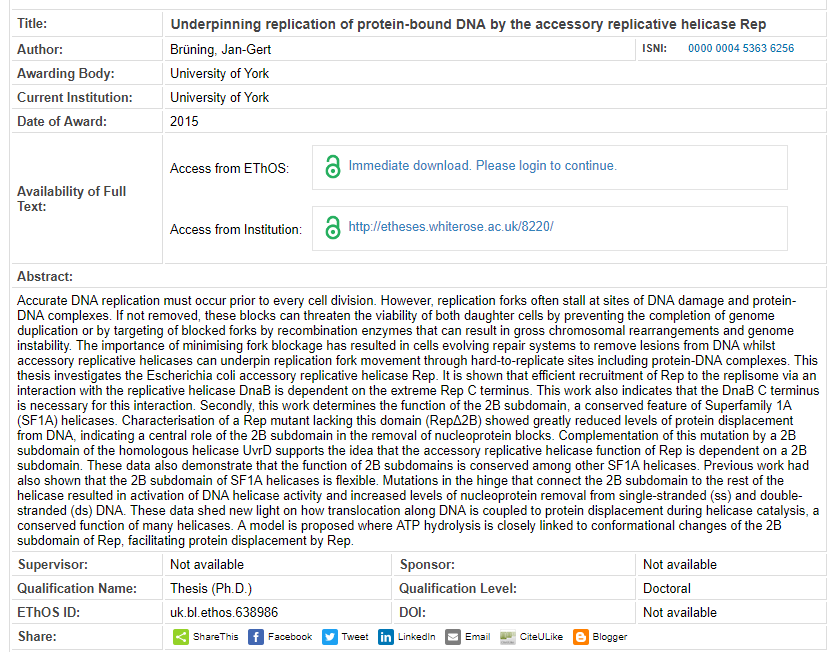
Continuing the theme of Open Access Week, Kirstyn Radford speaks to York PhD holder Dr Clare Cunningham about how an open access thesis can extend the reach of your research ...

For University of York postgraduate researchers, Open Access is not some far-off future aspiration like a professorship or a global patent - it’s a reality they plan for as soon as they start writing their thesis.  The University’s Policy on Research Degrees dictates that “all theses deposited by research students after examination... will be available to the general public for consultation and for reproduction (as permitted in copyright law)”, unless commercially-valuable or sensitive material is present.  An author can ask to embargo their thesis for a year or more whilst they explore commercial possibilities,  but by keeping their work under wraps, might they risk missing out on opportunities to develop their scholarly reputation at the point when their doctoral research is most newsworthy?

Accessing theses then...
From the earliest days of the University, successful York PhD holders were required to supply a bound volume of their thesis for the University Library, where it would be shelved in a locked room to protect it from unwanted attention.  Potential readers were expected to identify a title of interest from the Library Catalogue or the British Library’s Index to Theses, submit a request to read it, and collect it in person, for perusal strictly on the premises.  Readers who weren’t based in York and couldn’t travel were able to enjoy a microfilm version, sent by post.  (For our younger audience: a microfilm was like a ginormous reel of photos of the thesis, page by page. Black and white - well,  yellowish really. Easily torn, or tangled up in knots. Only readable on a machine the size of a photocopier).

Aware that this wasn’t an optimal delivery model for the fruits of their postgraduate researchers’ labour, the Universities of York, Leeds and Sheffield decided to collaborate on an online platform for theses: White Research eTheses Online (WREO).  Launched in 2008, WREO now holds over 14 000 theses and dissertations, almost all free-to-view,  except those which are embargoed for the reasons above.  In addition to all York theses examined since 2012,  WREO also provides a home for earlier titles which have been retrospectively digitized by the British Library due to popular demand,  including two dating from 1968, just five years after the University was founded.

...and now.
Most WREO records include a searchable abstract and keywords supplied by the author, to maximise the chances that the thesis will be well-placed in any list of Google search results. A stable and succinct url makes for straightforward citation and social media mentions.  A York thesis uploaded this year on the subject of bi- and multi-lingual children in English schools has already been downloaded 238 times!  (For comparison, the most widely-read thesis in the Library’s collection of bound volumes, also originating from Education, has been requested 19 times in 6 years).

Dr Clare Cunningham, author of the ‘most-downloaded’ thesis, has this to say about her first experience of Open Access publishing:
It seems such a shame to work on something for 7 years (in my case…!) and for it to only be read by your examiners and those people kind enough to proofread for you! And that’s why I decided to take it a bit further and actually cite it on other websites and posts I was writing, with a link to the White Rose repository: a great way to get your work read more widely.  I didn’t embargo it because I decided I wasn’t going to write a monograph straight from it, but even if you are, a thesis needs to change a lot to become a good book, so it may as well get read!
Rather than relying wholly on word-of-mouth or serendipitous Googling to attract readers to her thesis, Clare took advantage of a relevant scholarly society’s blog platform for postgraduate researchers, publishing a plain English summary of her doctoral work.  An approach from The Conversation’s editorial team followed, with an invitation to contribute an article on the social and political context in which teachers work with multi-lingual children in English schools, which has been read over 10 000 times.  Now employed as a Senior Lecturer in Linguistics at York St John University, Clare can look forward to many years of building her academic reputation on sound foundations: her examined thesis, free-to-view on a stable platform underpinned by the resources of three Russell Group universities.

Kirstyn Radford is a Research Support Librarian at the University of York.  She has worked in academic libraries for 25 years, long enough to remember when microfilm readers operated by electricity rather than hamster power were the latest innovation...

Tuesday, 23 October 2018

Open data and the scientific gift culture


Continuing our theme for International Open Access WeekProfessor Kevin Cowtan, Department of Chemistry, writes about the value of open data for scientific research.

If you've applied for a research council grant recently, you'll know that research councils have become rather keen on 'open data' in recent years. Funders would like us, not just to produce new results, but also to provide all the data used in deriving those results. Many journals are introducing similar requirements.

At first glance this might appear as research funders imposing more bureaucracy on grant holders. However I would like to suggest that open data is fundamental to how science works, and in addition that releasing research data can provide significant benefits to the researcher themself.

All science involves building on the work of others, or 'standing on the shoulders of giants'. This makes science a gift culture - we take the gift of the work of others and in turn gift our own work to others for them to build on. Making our results available sooner increases the opportunities for others to build on them, or if necessary to point out our errors, both of which increase human knowledge. Releasing our data often increases the value of our work, because other researchers can test our hypotheses and others against the data. In open source software, these benefits are characterized by the slogans 'release early, release often', and 'given enough eyeballs, all bugs are shallow'.

Or that is what is supposed to happen. But does it work in practice? I would like to highlight three experiences from my own career which suggest that it does.

Example 1: In the 1990s Dr Paul Emsley and myself developed a new piece of software for X-ray crystallography, called 'Coot'. University culture at the time was heavily focussed on the commercialisation of software outputs, however we (not without difficulty) made our work 'open source', meaning anyone else could build on our work, and we in turn could incorporate the work of others. This turned out to be a very good decision: Coot quickly surpassed and largely replaced all competing tools, and for the past few years the software has typically been cited in around 10 new peer-reviewed papers every day. The use of the software in industry as well as in academia produces an economic impact.

Example 2: Around 2013 I became interested in climate science, and identified a problem with how a major historical temperature dataset was being used. Users assumed that the data were global in coverage, when in fact they were not. I published a paper on estimating an unbiased global mean from the incomplete data, but also released the data and monthly updates from then on. The dataset has attracted over 200 citations and been used in official reports from government organizations. The name recognition this has generated has made it easy for me to build collaborations with climate scientists - which is not always easy when starting in a new field.

Example 3: In 2015 I identified a problem in how climate model simulations are compared with observations - the most commonly used method did not provide an 'apples to apples' comparison because of complexities of the historical data. A correct comparison involved some dull but careful data analysis. Again, I released the software as well as the data. Several subsequent comparisons have made use of this code, leading to both citations and co-authorships, at least one of which will be REF returnable.

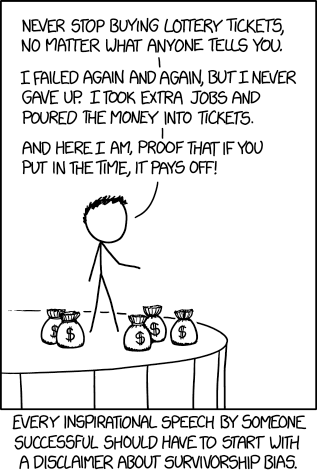
Image courtesy of XKCD, https://xkcd.com/1827 
under a CC BY-NC 2.5 licence
Now, this may all have been luck. After all, had I not had success in releasing data and computer code, I would not have been asked to write this blog post. There could be hundreds of people releasing data and not seeing any benefits. I could be the beneficiary of 'survivorship bias', explained by Randall Munroe in the comic XKCD.

However there are objective reasons to believe that releasing data does benefit the researcher. In 2013, Piwowar and Vision found that after controlling for a range of other factors, papers with open data received more citations than papers without open data. Open data also provides economic impact, estimated for example by Houghton and Gruen in 2014, which when measurable may be useful to the department and the researcher for REF "impact" studies.

In summary, open data is a natural extension of the principles of good scientific research: science is and has always been a social activity, and the gifting of information is fundamental to that activity. Studies of open data publications show benefits both to the researcher and to the wider economy. My own research career has been built on giving away data and computer code: not every case has led to benefits, but the net benefit over the course of my career has far outweighed the time cost of releasing the data.


Professor Cowtan is an interdisciplinary data scientist working in the fields of X-ray crystallography and climate science. While most of his career has been at the University of York, he has also spent sabbaticals at San Diego Supercomputer Centre. He is the chair of the university Research Data Management committee.

Monday, 22 October 2018

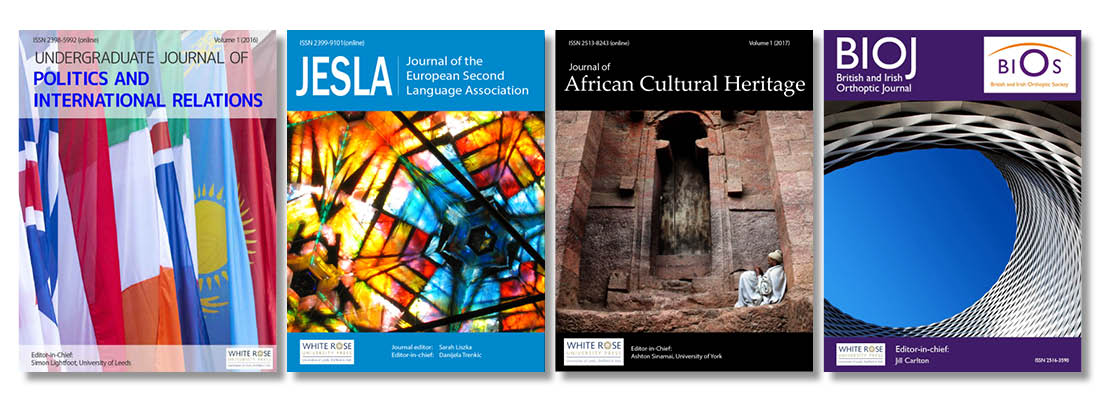
White Rose University Press: an Open Access publisher from the Universities of Leeds, Sheffield and York


To kick off our series of posts for International Open Access Week, Kate Petherbridge, White Rose Libraries Executive Manager, writes about the work of White Rose University Press and the benefits that open access publishing can bring for authors and the wider research community.


White Rose University Press (WRUP) is the library-led university press of the Universities of Leeds, Sheffield and York. It opened for proposals in 2016. Two years later, WRUP has made considerable progress from a standing start. Open Access (OA) Week 2018 seems a good opportunity to reflect on this progress and why new academic-led and university presses like WRUP are becoming more important in the HE environment.

Why an Open Access Press?

The White Rose Libraries (WRL) work together on different projects. WRUP is a product of this collaboration. One driver behind its creation was feedback from academics across Leeds, Sheffield and York universities who flagged that there were limited options for academics who wanted to publish their research OA. This coincided with institutional concern about the costs of buying content from traditional commercial publishers, and the growing focus on OA by funders and the government. WRL developed a not-for-profit university press to offer an OA publishing solution.

As a library-led press, WRUP operates in an area used to providing support to academics, and also with a focus on collaborative working. OA makes publishing evolve into an academic service, and WRUP enjoys working closely with its academic authors and editors. They have input into production choices, licensing, design, distribution and marketing for their publication. Feedback shows that academics appreciate the opportunity to work closely with the publisher in this way.

How does it work?

As with other academic publishers, books and new journals go through a formal proposal and full peer review process. Commissioning decisions are made by the WRUP Editorial Board, consisting of academics from across the three universities. Commissioned publications are produced to a high standard, with all the expected design elements and processes such as copyediting, typesetting, indexing etc. available.

What is different about OA?

OA publishing is different in some key ways, notably in the areas of dissemination, rights and funding.

Dissemination

OA books and journals are free for everyone to access online. You don’t need to be associated with an institution that can afford a subscription or to buy a copy of a book to access the research. The primary OA product is digital. WRUP offers its books and journals free to read online or downloaded in a variety of formats. This free global access means that academics, practitioners, policy-makers and the public all have the same access to high-quality academic research. WRUP also offers books for purchase via print-on-demand as OA publishers understand that people still want the option of a printed volume.

Rights

In traditional publishing, authors commonly sign their copyright over to the publisher. This can make it difficult for them to reuse sections of their own work. It is also a barrier to other academics freely sharing and building on that research. OA content is published under Creative Commons Licences. Authors retain the copyright to their work, and can use the licence to set the conditions around which others can copy, distribute, and make use of their work. This opens the research up in a way that traditional “all rights reserved” publishing does not. OA maximises the value of that work in terms of how it can be shared, but also how it can be built on and combined with other research in an evolving discussion.

Funding

This is a key source of contention around OA publishing. It’s a divisive issue and one that OA sceptics use to predict the long-term failure of the model. Many describe Gold OA (the WRUP model) as “author pays”. There are costs associated with the publication process and these have to be covered. In the case of WRUP these costs have been met through grant funding, funding from societies, or funding from the author’s own institution – the authors themselves have not had to pay.. A scalable solution is needed, however. Latest discussions include proposals from Science Europe’s cOAlition S. Their Plan S details 10 principles, some of which address fees (who should pay these, potential capping). It will be interesting to see how that conversation develops.

What are the benefits of OA?

There are many benefits to authors who publish in OA journals. OA articles tend to be viewed more than those that need a subscription, which often results in higher citation rates. OA articles can also reach a wider audience as they are not dependent on those who can afford the subscription cost. OA increases your visibility within your field and helps you build upon your academic reputation. It brings research to new audiences, inside and outside academia, and because of this there is likely to be greater public engagement. OA publishing makes your research easy to access if found through Google and other general and academic search services.

How is WRUP doing?

WRUP currently has four journals, each with its own editorial structure and peer review process. Two were “born” with WRUP, and two flipped from other publishing models. These journals have a mix of publishing patterns (from rolling publication of content to regularly publishing a defined volume) and cover a range of subject areas.

WRUP has also published three monographs since April:

•         Star Carr Volumes 1 and 2, Prof Nicky Milner, Dr Chantal Conneller, Dr Barry Taylor (eds.)
•         320 rue St Jacques: The Diary of Madeleine Blaess, translated and edited by Dr Wendy Michallat
•         Oysters, nightingales and cooking pots: Selected poetry and prose in translation. By Tristan Corbière, translated by Christopher Pilling, edited by Dr Richard Hibbitt and Dr Katherine Lunn-Rockliffe

Star Carr, WRUP’s first monograph, was downloaded nearly 1000 times in its first three days of release in April. Five months on and it has been downloaded over 4100 times by a global audience. 140 print volumes have also been sold via print on demand. The Madeleine Blaess diary, released a couple of weeks ago in September, has been downloaded over 230 times already. For context, the average commercial print run for monographs is now reported to be 150 copies, many of which sit on the shelves of HE libraries. The OA figures represent active engagement with the research.

What next?

The OA debate increasingly focuses on monographs. The expected expansion of OA requirements to monographs in the third Research Excellence Framework (REF) was flagged in 2016. Research England continues to move this forward and explore how the policy could work. It is an advantage for academics of Leeds, Sheffield and York to have a “friendly” OA University Press to offer support and information. WRUP colleagues are happy to answer any questions about OA in general, or to discuss potential proposals for journals or monographs. To get in touch email universitypress@whiterose.ac.uk or ring 01904 323803.

WRUP has more publications in the pipeline, including monographs on Capability Brown, the ongoing cultural legacy of Charles Dickens, and the prehistoric development of human social emotions. It’s exciting to see so much fantastic work made freely available to all, and add to the growing pool of OA scholarship.


As White Rose Libraries Executive Manager, Kate Petherbridge works across the university libraries of Leeds, Sheffield and York, leading and facilitating their areas of collaboration. These are varied, and include shared repository services, shared collection management work and, most recently, White Rose University Press.